
OEM LED Display Partnership: How Distributors & Integrators Work With Our Factory
An OEM LED display partnership means you sell screens built in our factory under your own brand, in your territory, with our name kept out of it. We build, test, certify and back the hardware — you sell, install and service it. This guide covers the economics, the OEM/ODM/white-label differences, the channel-conflict question, and every way we have watched these deals fall apart.
You already buy LED screens somewhere. Through a regional led display distributor, who adds 20–30 points on every cabinet. Through a marketplace listing — a pallet and a prayer, half the modules arrive fine and the other half you eat. Or directly from the factory that builds the thing.
The direct route is cheapest on paper. It also fails more often than the other two, for reasons that repeat so reliably you can script them in advance. Distributor surveys put the fear at the top of the list: you send a factory your sample order, the factory likes your market, and six months later it is quoting your end clients behind your back.
That one is theft.
Failure two is warranty arithmetic across borders: a power supply dies in month fourteen and nobody agreed who pays the freight from Manchester to Shenzhen. Failure three is spare-part latency — your request sits in a shared inbox for eleven days while the client’s screen cycles test patterns at a trade show. Failure four is paper: the CE certificate in the shipment carton carries a different company’s name.
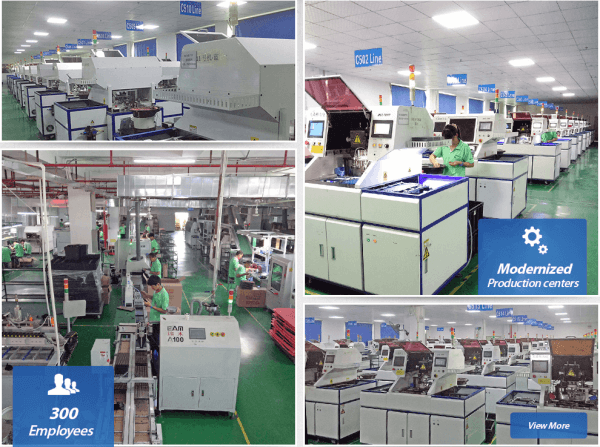
More than ten years on the factory side of this table. 630 cabinets shipped to a UK rental firm that still buys from us and takes partner reference calls. Seventy pole screens running across the US. LED cubes inside the Whitney Museum; projects in Portugal, Italy, Brazil, Malaysia and Nepal; a site in twelve languages because partners’ engineers work across time zones. This article is the failure list, then the process that keeps each item from happening.
OEM, ODM or White Label — Which One Are You Actually Asking For?
First emails use the three terms interchangeably. They are different contracts with different ownership, and asking for the wrong one burns three weeks of engineering.
| Modelo | What it means | Who owns what | Fits when |
| OEM | Your brand on our proven hardware — your logo on frame, boot screen, packaging | You own the customer, the brand, the sell price. We own the tooling, BOM and production know-how | You have sales and service capability and want factory economics under your name |
| LED display ODM | Custom engineering — different pitch, cabinet size, curved corners, unusual control | You own the application. We own the manufactured design unless the contract transfers it — negotiate that before the first drawing | Your project genuinely cannot use a standard range, and it repeats at 100+ units/year |
| White label LED display | Our standard product, your box | We keep the product identity; you get resale rights and whatever branding depth the contract states | You need stock fast and customers buy on price and delivery, not badge |
The trade-off is blunt: the deeper the branding, the slower and costlier the start. A white label order can ship inside three weeks. An ODM program eats a quarter before the first cabinet exists — tooling, NRE, a 30–40 day first-article cycle. OEM sits between: our hardware, your skin, 15–25 days for a first production run.
The MOQ Question, Answered Honestly
Published import guides converge on two industry-common numbers: 5–10 m² minimum for standard screens, and around 50 units for full white-label customization at large generalist factories.
Those figures describe the giants. Ours is more flexible, and here it is in writing:
- Sample: one cabinet. Air freight, credit card, 7–15 days production. We would rather ship a sample than lose the conversation.
- OEM branding: from about 20 cabinets. Below that, the branding engineering costs us more than the order earns — and telling you that before you spend a week on artwork is the partnership working, not failing. (Exact threshold [需公司确认].)
- Pilot project: 10–50 units. The realistic first commercial step; most partners reach a first full container within two or three orders.
If you complete fewer than two or three LED projects a year, honestly, don’t do OEM. Buy standard stock per project and come back when the calendar fills.
The Channel-Conflict Conversation: Have It Before the First PO
This section decides whether we work together for five years or one.
We run a 12-language website. Inbound inquiries land from everywhere — including your city, and occasionally your own prospects. Every serious distributor eventually asks the question: will you sell direct in my market?
Direct answer: where a signed partner holds territory or account protection, no. Registered projects are routed back to the partner at the partner’s price. Where we have no partner yet, yes, we sell direct — a factory with global inbound does not refuse orders. That is precisely why the written channel policy comes first: it defines where “no partner yet” ends.
A serious answer has three parts:
- Written territory or account policy. Which cities, accounts and verticals are yours — inside the agreement, not in a hallway conversation at a trade show.
- Project registration. You register a deal, it is protected for a defined window, and matching inbound gets routed back to you at your price.
- Price discipline on repeat models. You quote a client on a model; we do not undercut our own partner on that same model six months later.
Two honest limits of any such policy. We will not pretend to police global marketplaces, where end buyers find factory listings no matter what anyone signs — account protection targets named accounts and registered projects, because that is where real money moves. And territory protection is earned by activity, not granted by enthusiasm: a partner who registers nothing and orders once a year will not keep a country locked. I say this before anyone asks for exclusivity, because exclusivity granted generously and revoked quietly is worse than a narrow policy kept honestly.
The failure mode, stated plainly: a factory that promises everything verbally will sell direct the first time a large inquiry lands. A partnership that starts with a verbal territory promise ends with a lawyer. If a supplier will not put channel policy in writing before your first PO, treat that silence as the answer.
I put ours in the first email. You only have to ask.
What the Economics Actually Look Like
A worked example with market-median numbers, every assumption labeled. Product: P3.91 indoor rental panels — the workhorse of rental and staging, same family as the UK 630-cabinet deployment.
Assumptions: buy at $775/m² FOB (midpoint of the $650–900 market-median range); freight and duty at 30% (industry guides say 25–40%); sell at $1,800/m² installed (midpoint of $1,400–2,200, illustrative — verify against your own market); install crew at $50/m² on a 20 m² job down to $25/m² at 150 m².
| Line | 20 m² project | 60 m² project | 150 m² project |
| Revenue at $1,800/m² installed | $36,000 | $108,000 | $270,000 |
| Factory cost at $775/m² FOB | −$15,500 | −$46,500 | −$116,250 |
| Freight and duty at 30% | −$4,650 | −$13,950 | −$34,875 |
| Install crew | −$1,000 | −$2,100 | −$3,750 |
| Gross margin per project | $14,850 | $45,450 | $115,125 |
| Gross margin | 41% | 42% | 43% |
At three realistic partner profiles: a small integrator running 4 × 20 m² clears about $59,000 a year; a growing distributor at 6 × 60 m², about $273,000; an established one at 8 × 150 m², about $920,000.
Now the downside, because the upside is easy to find. Run the bad end: $900/m² FOB in small volume, freight at 40%, a market that only supports $1,400/m² installed. Landed cost is $1,260/m²; margin before labor is $140/m². There is no business in that spread. The gap between buy and sell has to clear freight, duty and labor, or the project is a favor, not a company. We run this math with partners before quoting — if your local selling price can’t clear the bar, we say so and point you toward stock product.
And one caveat the table cannot show: that 41–43% is gross, not net. It is compensation for the work the factory does not do — finding the client, rigging screens at six in the morning, taking the 2 a.m. support call. Anyone whose pitch implies you keep factory economics without factory-scale service work is selling you the spreadsheet, not the business.
What OEM Customization Actually Costs
OEM sounds like a logo request. On our line it touches six places: modules, cabinet corners, boot screen, control software, cartons, manual. Six separate jobs, each with its own cost and its own cutoff.
| Customization line | Market-typical cost | What you get |
| Logo on modules or cabinet corners | +$2–5 per cabinet | Silkscreen or plate — must be specified before production, not after |
| Custom packaging | +$3–8 per cabinet | Printed cartons under your brand |
| Boot screen and CMS rebrand | $300–800 one-time | Your logo at power-on, your platform name inside the software |
| Custom manual or quick guide | $200–500 per language | Branded PDF carrying your support contacts, not ours |
The detail nobody advertises: box printing runs at 500+ boxes per design. If your first order is 40 cabinets, printed boxes cost more than the branding itself. So most first orders ship in neutral packaging with branded accessories — flight-case tags, cable labels, branded manuals — and printed cartons arrive when volume justifies the plate. Once artwork is locked before production, branding rides along inside the standard 15–25 day window and adds nothing to lead time.
Anchor those lines to the 60 m² project above: 240 cabinets, so logo plus packaging adds roughly $1,200–3,120 across the entire build — 3–7% of that project’s $45,450 gross margin. The one-time fees amortize to almost nothing by the second order. This is why the white label LED display conversation is worth having at volumes most integrators assume are too small.
Who Does What: The Division That Prevents Year-Two Wars
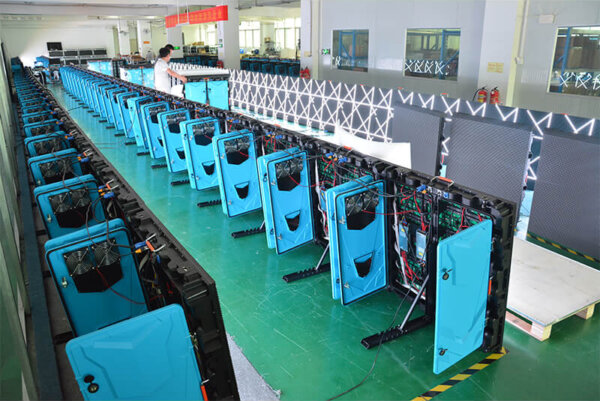
Half the failed factory partnerships we have seen died over an unclear division of labor, not over bad panels.
| Function | Factory side | Your side |
| Design, BOM, production, 72-hour aging tests | Owns | Advises on spec |
| Certifications — CE, FCC, RoHS, UL options | Holds and supplies documents | Verifies and files for tenders |
| International freight, customs paperwork | Books and documents | Owns import compliance in-market |
| Sales, client relationships, pricing | Stays out entirely | Owns |
| Installation, rigging, commissioning | Remote technical support | Owns on site |
| First-line service and warranty swaps | Ships parts against SLA | Diagnoses and replaces locally |
| Branding and marketing assets | Supplies on request | Owns the client-facing brand |
Read the warranty row twice. From our floor we diagnose remotely, and we put a module on a plane fast. We cannot drive a van to a venue in Lisbon or Dallas. The 5% spare parts in every order exist precisely so you can: a module fails in Rotterdam, your technician swaps it from stock the same week, nobody waits on a flight from Shenzhen. Year-one replacement freight is on us. Months 13–36 freight terms go into the agreement — negotiable, but never discovered in month 20 during a breakdown call.
If you need documents for tender files, the CE, FCC, RoHS and UL certificates and manuals sit on our download page — check them before you bid, not after. And check that the certificate name matches the invoice name at any factory you vet; mismatches end with you explaining a stranger’s letterhead to an inspector.
The 7-Question Checklist That Tests Any Factory
Any OEM LED screen manufacturer says yes to everything on a sales call. Put the questions in writing and make the answers contractual — send this list to us and to every factory on your shortlist.
- “Will you put the territory and channel policy in writing?” Not a verbal assurance — a clause, with a defined consequence for breach. A channel policy without a penalty is a suggestion.
- “What are the warranty mechanics across borders?” A module fails in month fourteen — who pays freight, who pays labor, how many days until the replacement leaves the dock? Demand days, not adjectives.
- “What is your spare-part latency commitment?” We ship 5% spares with every order, weighted toward the components that statistically fail first. Beyond that stock, ask for a written dispatch SLA. “We will try to help quickly” is not an SLA.
- “Under whose name are the certifications?” Ours, matching the invoice — that is how CE, FCC, RoHS and UL legally work, and tender evaluators know it. What a factory can white-label: data sheet packs, test reports for bids, and an engineer on a reference call with the tender committee. (Exact SLA hours [需公司确认].)
- “How deep does the white labeling go?” Boot screen, cabinet stamps, flight-case labels, printed manuals, CMS rebrand. Ask for photos of a previous partner’s shipped order — a factory with real OEM volume has them in a phone album.
- “Which existing partners can I call?” Not testimonials — phone numbers. We connect prospects with active references, including the UK firm running our 630 cabinets.
- “Will you open the factory — video or in person?” A live walk-through of the SMT lines, aging racks and QC benches. We do both routinely; refusal is rare, and when it happens, believe it.
Score the written answers, not the calls. The spread between factories’ replies is your real diligence.
The First Order Ramp: Sample, Pilot, Container
Nobody sensible starts with a container, and no factory worth partnering with should push you to.
Stage 1 — Sample, weeks 1–4. One cabinet, air freight, credit card. Test it with your own meter: brightness, uniformity after 72 hours of aging, true power draw. A confident factory wants you measuring, not admiring.
Stage 2 — Pilot project, weeks 5–12. 10–50 units against a real client job, T/T 30/70, sea freight. This is where you learn the truth about packing quality, documentation and spare handling — deliberately, where the downside is one client instead of your whole fleet.
Stage 3 — Stocked container, months 4–9. LCL becomes FCL, you hold inventory, and the price-protection conversation begins — if panel prices fall while your stock sits in a warehouse, that risk has to land somewhere both of us can survive. We set protection windows for stocked goods at this stage, on purpose, not during a dispute.
Six to nine months from first email to your own warehouse stock. Partners who compress this by skipping the pilot generally pay for it later, publicly, in front of a client.
What a Good Partnership Agreement Covers in Year Two
The first year tests the product. The second year tests the partnership. Four clauses keep ours alive:
- Price review cadence. Panel costs trend down over a cycle. A factory that never reviews price is quietly making your shelf uncompetitive; a partner who demands a fresh quote monthly is wasting both our afternoons. Twice a year, benchmarked, in writing.
- Spares replenishment. You consumed the 5% on real jobs — reorder at partner pricing on a predictable cycle, before a stockout turns a routine swap into a two-week apology.
- Marketing asset sharing. Job-site photos, case studies, white-label data sheets. A partner with a thin catalog sends prospects straight to our site, which helps neither of us.
- Lead-time reservation. Rental peaks in spring; retail peaks before Q4. Send a forecast and we reserve line capacity. Partners who forecast get slots; partners who do not get squeezed behind the ones who did.
Plus the currency clause people forget: your revenue is dollars or euros, our cost base is yuan, and a 10% swing rewrites both margins. Set review triggers at the start, while everyone is still friendly.
FAQ
Will you sell direct in my market? Where a signed partner holds territory or account protection: no — registered projects route back to the partner at the partner’s price. Where we have no partner yet: yes. The written channel policy defines the boundary, and I would rather prove it with partner references than with adjectives.
What is the minimum order to start? One cabinet as a sample, air freight, credit card. OEM branding starts at about 20 cabinets (the engineering has to earn its keep); the realistic first commercial step is a 10–50 unit pilot, and most partners reach a first container within two or three orders.
Who pays freight when a part fails in month fourteen? The split is written into the agreement: we pay the part and outbound factory freight on confirmed warranty failures; you handle local freight and labor. The 5% spare stock absorbs most first-year failures with no freight at all.
Can we white-label your certificates? No — certificates name the factory; that is how certification legally works. What we provide instead: white-label data sheet packs, test reports you can attach to bids, and an engineer on the call when a tender committee wants to hear from the manufacturer directly.
OEM or ODM — which do I actually need? Reselling standard screens under your brand is OEM. A product the market does not make, sold repeatedly at 100+ units a year, is ODM — with tooling and NRE budgeted from day one. A one-off special is neither: buy standard product and solve it with integration. Nine of ten distributors we talk to need OEM, not ODM.
How long from PO to a container at my warehouse? Production 15–25 days for a standard OEM configuration, plus a week of pre-shipment aging and QC, then sea freight — about four weeks to western EU ports, four to five to US coasts. Realistic total: six to eight weeks.
Bring Us Your Market Plan
Ask for our partnership terms — territory policy in writing, partner references you can call, and a live video factory audit this week: contact our OEM team. You can read about our factory and certifications first. Either way, have the channel conversation before the first PO — that is the lesson of ten years on this side of the table, and I would rather you learn it from us than from a lawyer’s invoice.