
Church LED Wall Buying Guide: Sizes, Pitch, Budgets
A church LED wall for a 300-seat sanctuary should run $19,000–32,000 all-in at factory-direct pricing — not the $40,000–150,000 that shows up on most US integrator quotes. The panels inside both numbers are often the same hardware. What changes is how many hands touch the project between the factory floor and your stage wall, and how many marks each hand takes.
I’ve been on the manufacturing side for over ten years at Centro de atención, and every week a pastor or volunteer tech lead forwards us a quote asking the same question: is this just what it costs? It isn’t. This guide is the document to bring to your elders or finance committee — the manufacturer’s math, the engineering nobody quotes, the questions that expose padding, and a three-line summary you can read aloud at the meeting.
What the wall actually does on a Sunday
Start with the jobs, not the spec sheet. Between the opening song and the benediction, a church LED video wall does five things:
- Lyrics, faded in and out by a volunteer running on Friday-night rehearsal sleep.
- Sermon points and scripture, plain text, on screen for minutes at a time.
- IMAG — the live camera shot of the preacher, put up large so row 30 sees his face.
- Video announcements, the ones nobody can skip.
- Livestream backdrop, where the wall sits behind the preacher on YouTube for the next five years.
Name the jobs and the spec writes itself. Lyrics alone don’t justify much. But the moment a camera points at the preacher with the wall behind him, you’ve committed to refresh rate, color temperature and brightness control — quoted or not. Most churches find this out a year late, watching their own baptism footage roll on camera.
Sizing without regret
Two measurements decide the whole thing: the distance from the front pew to the wall, and the distance from the last row. Bring both numbers to every conversation.
A vendor who sizes a wall without asking for them is sizing a commission.
| Sanctuary size | Suggested wall area | Common shape (16:9) | Front pew | Last row |
| ~150 seats | 8–10 m² | 4.0 × 2.25 m | 3–4 m | 10–12 m |
| ~300 seats | 18–24 m² | 6.7 × 3.2 m | 4–5 m | 18–22 m |
| ~500 seats | 30–40 m² | 7.7 × 4.3 m | 5–6 m | 25–30 m |
| 1,000+ seats | 40–80 m² | Often wider than 16:9 | 6 m+ | 30 m+ |
The regret runs both directions. A wall sized for the back row washes out the front three pews; a wall sized for the front pew leaves row 40 reading a screen the size of a hymnal. And keep the wall close to 16:9 — your lyric software builds 16:9 slides, and anything else letterboxes into dead zones a volunteer nudges text around for the next five years.
Pitch without theology
Pixel pitch is the gap between LED pixels, in millimeters. P3 means 3 mm. Lower number, tighter pixels, sharper up close, more money. That’s the entire doctrine.
The working rules: minimum comfortable distance is roughly the pitch in meters, and text stays readable at roughly 6–8× the pitch. Run the math your committee should have asked for: front pew at 4.5 meters — there, P2.5 and P3 are visually identical, both far past their sharpness threshold. Last row at 20 meters couldn’t tell P3 from P4 with binoculars. So P2.5 buys sharpness nobody in the building can see, at roughly a 40% premium.
| Pitch | FOB per m² (market median) | Right when |
| P2.5 | $900–1,400 | Front rows closer than 3 m |
| P3 | $650–1,000 | Most sanctuaries — the default |
| P4 | $500–800 | Front rows beyond 4 m, tight budgets |
Print those numbers before any meeting. A quote at $2,000/m² for P3 is a quote with room in it. We break the pitch decision down further, wall by wall, in our pixel pitch guide.
The livestream spec elders never hear about
Three specs decide whether an LED screen for church livestream duty is an asset or an embarrassment, and none of them appear on a typical church quote.
Refresh rate: 3840Hz, in writing. The physics, in two sentences: an LED wall never glows continuously — every diode is switched thousands of times a second by its driver chip, because pulse-width modulation is how a wall dims at all. Your camera shutter samples that strobing on its own clock, and any mismatch shows up as dark bands crawling across the frame. A 1920Hz wall looks flawless in the room. On camera, it bands. Refresh lives in the driver ICs, so it is fixed at the factory and belongs in the contract, not in a conversation. The discovery lives in the archive: six months of uploaded sermons, every one striped like a broken television, and there is no firmware fix. Churches on 960Hz walls have ended up buying the wall twice. I have seen that invoice.
Brightness is a dimming problem, not a maximum. An indoor sanctuary needs 800–1,200 nits at peak — that number is on every brochure, so it tells you nothing. What matters is the other end of the dial, because a sanctuary wall spends its whole life dimmed: lyrics at 9 AM with lights up, communion with lights down to a whisper, IMAG during a baptism with water reflections crawling over the preacher’s shoulder. Cheap driver ICs fall apart down there — grays crush, faces posterize, dark scenes band. So demo any wall at 5% brightness, not 100%. Every factory looks good at full power; watch the skin tones in a dim scene at 5%. If they turn gray or noisy, the ICs are the cheap kind, and an auto-dimming sensor becomes non-negotiable — baptism Sunday is the test: white robes, reflective water, house lights low. Without auto-dim, the wall blows out and the camera clips to white.
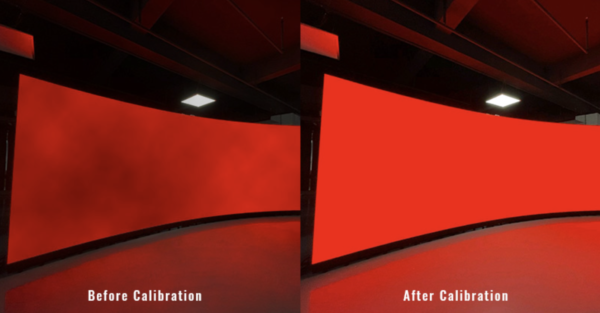
Color temperature for IMAG. Skin tones are the honest test of a wall. A wall calibrated near 6500K keeps the preacher’s face natural when the IMAG shot fills the screen; an uncalibrated one drifts blue or magenta and every stream looks like a 1990s camcorder tape. One technical fix most quotes skip: set the camera’s white balance off a gray card lit by the wall itself, not the ceiling LEDs — the wall and camera are in a loop, and the encoder records the wall’s rendering of the camera’s rendering of the preacher. Calibration is a commissioning step, not a menu setting. Ask if it’s included.
The building is part of the spec
Now the section no salesman brings up, because it has nothing to sell: a church led wall almost never fails for screen reasons. It fails for building reasons.
A 21 m² wall plus its support frame weighs 700–1,000 kg, and it will hang on your sanctuary wall for a decade. So the first site question has nothing to do with the screen: what is behind the drywall? Concrete or block — easy, anchors bite, mounting cost is mostly labor. Steel studs — the answer most modern sanctuaries are hiding — hold up drywall, not a tonne of electronics on point loads. The fix is a freestanding steel support frame, floor-standing and braced, plus a local engineer’s letter. That frame can cost more than the panels. I have watched it happen.
Thermal matters too: a wall sealed flat against another wall has nowhere to dump its heat, so spec a convection gap top and bottom or fanless cabinets. And it is not only heat — a baptistry pump running Sunday morning pushes humidity through the room, and weekly HVAC swings walk the structure through expand-and-contract cycles for years. Spec locking connectors, and ask the factory how the cabinets breathe. While you’re at it: front-service modules are non-negotiable for a sanctuary wall, because behind that wall there is usually nothing — a mechanical room, an adjacent wall. A volunteer with a magnet tool and a ten-minute video call replaces a module from the front. No drywall surgery. No dead wall waiting on a truck.
Power is real but manageable: a 21 m² wall draws roughly 2–4 kW playing normal content (an all-white test frame peaks several times that), so give it its own dedicated circuits, run by an electrician, sized off the cabinet’s max-power sheet. And noise: cabinet power supplies whistle at a pitch that vanishes during worship and reappears, mercilessly, during the quiet prayer. We default to fanless or quiet-fan cabinets for sanctuaries.
Three church LED wall budgets
Here’s the panel math at market-median FOB, then what the whole project actually costs:
| Build | Wall | Panel math (FOB) | All-in, factory-direct |
| Chapel, ~150 seats | 10 m² P3 | 10 × $650–1,000 = $6,500–10,000 | $10,000–17,000 |
| Sanctuary, ~300 seats | 21 m² P3 | 21 × $650–1,000 = $13,650–21,000 | $19,000–32,000 |
| Large sanctuary, 1,000+ seats | 40 m² P2.5 | 40 × $900–1,400 = $36,000–56,000 | $48,000–80,000 |
The all-in column adds the lines volunteers forget: video processor ($1,500–4,000 depending on scale), receiving cards, power and signal cabling, mounting structure, sea freight and duty (25–40% over FOB), and the 5% spare-modules kit. A church video wall price that skips any of those lines isn’t cheaper. It’s incomplete.
Now the comparison nobody in either camp likes to say out loud. The $40,000–150,000 integrator package buys real things: a crew that shows up Tuesday, same-week service when a receiver card dies on a Saturday, the engineering letter, someone to blame. For a church with no tech volunteers and a facilities guy already drowning, that’s honest value, and I won’t pretend otherwise.
Factory-direct buys the same panels for 40–60% less. The trade: your team handles the install with our drawings and a scheduled video call, and service happens across a time zone instead of across town. We ship 5% spares and back the wall with a 3-year warranty because that trade needs a safety net. Our indoor fixed LED display line is what most sanctuaries end up buying; the same breakdown logic behind our taxi-top LED cost guide went into the table above.
One warning from the field: make both quotes describe the same wall before comparing them. Same refresh rate. Same front service. Same spares kit. I have watched a committee set a $28,000 factory-direct spec beside a $75,000 integrator spec and miss that one of them was 960Hz.

The 7 questions that expose padding
Send this list to every vendor, integrator and factory alike. The answers sort them faster than any reference call.
- What’s your price per square meter, by pixel pitch, itemized? Vagueness here is where padding lives.
- Put the refresh rate in writing. “High refresh” is not a spec. 3840Hz is.
- What’s itemized versus bundled? “Processing included” can hide a $2,000 processor marked up threefold.
- Are spares included, and how many? Under 3% is decoration. We hold 5% as the honest number for a wall nobody local can service quickly.
- What’s the warranty length — and who pays freight in month 14? A warranty that ships a dead module back to Asia on your dime is a brochure, not a promise.
- References from other churches. Call one on a Tuesday. Ask what broke and how long it stayed broken.
- Can we see the wall running our content before we sign? Send your actual lyric slides, a sermon clip, your announcement video. Any confident vendor will demo over video call. The one that won’t has a reason.
None of these questions are hostile. Good vendors answer seven of seven in one email — it’s the same list our best customers send us.
Seven mistakes churches make
Seen from the factory floor, church projects fail in the same places.
- Buying pitch for the front row only. The elder with the best seat picks the sharpest panel, and the other 95% of the room pays for it.
- Forgetting the processor in the budget. Panels without a processor are a very heavy jigsaw puzzle.
- No spare plan. A module dies in year two. If 5% spares sit on a shelf in the church office, it’s a 20-minute volunteer swap. If not, a three-week negotiation.
- Under-specified mounting. The wall hangs on your building, and a 21 m² wall weighs hundreds of kilograms. Get a structural engineer to bless the wall before the modules ship — the one line item I refuse to watch churches skip.
- Buying brightness the room never uses. Fifteen-hundred-nit panels in a room that runs blackout blinds have lived at 40% output since day one. The vendor knew about the blinds. Nobody asked him.
- No content plan. A dead wall showing one static slide is a very expensive felt banner. Assign someone to own the slides before install day, not after.
- Paying integrator markup on panels a factory ships worldwide. The same sealed boxes leave the same ports for integrators and for churches.
Same panels. Different margin.
The three-line committee summary
Copy this block, fill the brackets, and put it on the first page of your packet. It’s the whole argument in the shape elders actually approve things.
| Line | Your committee summary |
| What we’re buying | A [21] m² indoor LED wall, P3, 3840Hz refresh, front-service modules, processor, mounting structure, 5% spares, 3-year warranty |
| What it costs | $[19,000–32,000] all-in, itemized quote attached, [40–60%] below comparable local integrator bids |
| Why it’s the right spec | Sharp from the front pew at [4.5] m, readable from the last row at [20] m, camera-safe for livestream and archived services, volunteer-serviceable with spares on site |
Three lines. Every follow-up question the committee asks is answered in this guide, now attached behind it.
FAQ
Can our volunteers install it? The panels: honestly, yes. Two competent people, a lift, and our video supervision on the phone hang a wall over a weekend — panels hang in numbered order with locking connectors. The structure is different: that takes a local contractor and, on stud walls, an engineer’s letter. Panels are a volunteer task. Structure is a licensed one.
How long does an LED wall last? The diodes carry a 100,000-hour rating, which flatters the component least likely to fail. The real killers are power supplies and water — and a baptistry-adjacent wall breathes humidity every Sunday. Run ten hours a week, expect 10–15 years of full service, with PSUs the usual first service item in years 5–8. That’s why our warranty covers 3 years with PSUs included, and every church order ships a 5% spares kit.
Is P2.5 worth the upgrade over P3? Not for most sanctuaries. It costs roughly a 40% premium and buys sharpness visible only inside 2.5 meters. If your front pew sits beyond 3 meters, the money buys more P3 wall instead — which everyone in the room can actually see.
Will it work with our existing software and gear? Yes. To ProPresenter, EasyWorship, Resi, or whatever runs your slides and stream, the wall is just a very large monitor: your lyric computer outputs over HDMI or SDI into the video processor, the processor feeds the wall. Your existing IMAG switcher plugs in the way it does to a projector today.
What happens when a module dies mid-service? Almost nothing, if the spec was written right. One tile goes dark among hundreds, the service continues, and after the benediction a volunteer pulls the module from the front with a magnet tool and a spare from the kit. Ten minutes. No ticket.
Is a used LED wall a sensible way to save money? Rarely, for churches. Used panels carry unknown hours, no warranty worth the paper, refresh rates too low for camera work, and no spares pipeline — a pallet of used P4 can’t be matched when modules fail. The exception is panels under two years old with documented hours and a transferable warranty. Everything else is buying someone else’s month 14.
Send Us Your Sanctuary
Send a photo of your sanctuary wall and the two distances — front pew and last row. The spec comes back within a day, itemized for your committee: pitch, size, refresh rate, structure plan, and a landed price line by line.