
LED Sphere Display Guide: Sizes, Prices & When a Ball Beats a Wall
An LED sphere display is a spherical screen built from custom-shaped tiles that plays one video canvas across 360 degrees. Venue quotes run $2,000 to $25,000+ FOB depending on diameter, pixel pitch and structure. This guide sizes the ball to your space, prices it honestly, and flags the cases where a flat wall does the same job for less.
Walk through any mid-size shopping centre in Southeast Asia or the Gulf this year and you will pass one. A glowing ball hung in the atrium, cycling brand films and festival countdowns, with a queue of phones pointed up at it. Marketing directors see it, boards ask about it, and the enquiry lands in our inbox the same week: can we get one?
Here is the problem. The quotes for “an LED ball” run from $2,000 to $25,000, and almost nobody explains the spread. The gap is mostly diameter, pixel pitch, and whether structural engineering and content are included — three things a first-time buyer cannot see in a PDF quotation.
I project-manage sphere builds at Eyecatchmedia, from 0.6m tabletop globes to the two-metre-plus LED ball screen we engineered for Malaysia. A sphere is the hardest geometry in our catalogue, and the reasons why never make it into most buyer’s guides: every tile is a custom shape, every seam is a curve, the weight lands on somebody’s ceiling steel, and the content has to be authored for a planet, not a page. If you are comparing quotes right now, tile count and kilograms will tell you more than pixel pitch.
What an LED Sphere Display Is
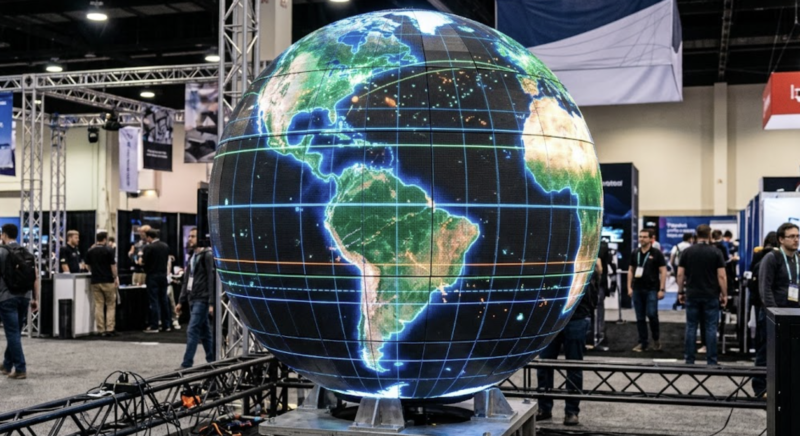
An LED sphere display — also sold as an led ball display or led ball screen — is not a flat screen bent into a curve. It is a sphere clad in custom-shaped LED tiles: triangular panels near the poles, trapezoid panels around the equator, machined so the seams follow latitude lines. No flat faces anywhere. Electronically it behaves as one canvas: a controller stretches a single video across the whole surface, and walk around it, the picture keeps going. That is the entire product — no front, no back, no dead angle.
Two things buyers underestimate. First, the panel geometry is custom tooling, which is why a ball costs more per square meter than a flat wall of the same pitch. Second, a sphere is a structure first and a screen second — internal steel, mounting points and access hatches all live inside the shell, roughly 450 kg of it for a 1m ball, and they are either quoted or forgotten.
We built one of the public reference points in this category: the Malaysia ball screen, shipped as a complete engineered package. Read it before you collect quotes — it shows what “included” should look like.
Why You Can’t Tile a Ball with Rectangles
Start with the geometry problem nobody quotes around. A sphere cannot be flattened onto a plane without distortion — try peeling an orange in one piece. Flat LED cabinets are rectangles for exactly this reason: a wall is a plane, so rectangles tile it perfectly and every module is identical. A ball gives you none of that.
Why not just bend flexible modules around it? Because a tile that bends left-to-right still cannot bend up-and-down at the same time. Flexible modules solve gentle single-axis curves — cylinders, soft waves, the work in our flexible LED display guide — but a true sphere wraps in two directions at once. Custom rigid tiles remain the honest answer.
So we build latitude bands. The sphere is sliced into horizontal rings, like an orange stood upright. Tiles in the middle bands come out as trapezoids — wider at the outer edge, narrower as the ring climbs toward the pole. The last rings at each pole collapse into triangles, because the circumference approaches zero and a trapezoid has nowhere to go. Every band carries different tile geometry, which means every band is a different mold, a different machining run, a different alignment jig.
And here is the paradox that surprises buyers: seam density explodes as diameter shrinks. Curvature per square metre is more aggressive on a 0.8m ball than a 2m one, so the same surface area divides into more custom tiles, more corner joints, more alignment hours. The fixed costs — receiving cards, power chain, control system, structural frame — also refuse to shrink with surface area. A small ball costs more per square metre than a large one. When a 0.5m globe quotes higher per m² than a 2m landmark piece, that is not padding. That is geometry.
Is a Sphere the Right Geometry?
The honest test is one question: does your content need 360 degrees? A sphere shows itself from everywhere. That is the point, and that is the cost — you pay to clad a full surface that every sightline sees. If your content is a logo animation or a promo loop that really faces one way, three quarters of the surface plays to views nobody needs, and a flat wall or a cylinder does the same job for roughly half the price.
| Geometry | Best for | Relative cost | Viewing angle |
| Flat wall | Retail, corridors, stage backdrops | 1× baseline | Front-facing |
| Cylinder | Columns, bars, wraparound lobbies | ~1.2–1.5× | ~360° horizontal |
| Cube | Brand objects, museum installations | ~1.5–2× | 4 faces + edges |
| Sphere | Atriums, plazas, landmarks | ~2.5–3× | True 360° |
The wider creative line — spheres, cubes, cylinders, ribbons — sits on our creative LED display page. My opinion from the inquiry file: most ball enquiries should be cylinders. The ones that should not are the ones where the ball becomes the landmark — where people say “meet me at the ball.” If you cannot picture that sentence being said in your venue, buy the cylinder and spend the difference on content.
Sizing an LED Ball to Your Space
Diameter is decided by two numbers in your building: ceiling height and viewing distance.
| القطر | Typical setting | Surface area | Approx. weight | Min. viewing | Min. ceiling, hung |
| 0.5–0.8m | Retail window, booth | 0.8–2.0 m² | 120–300 kg | 2–3 m | ~3.5 m |
| 1m | Mall atrium centerpiece | ~3.1 m² | ~450 kg | 3–5 m | ~4.5 m |
| 1.5m | Museum, edutainment | ~7.1 m² | 900–1,100 kg | 5–8 m | ~6 m |
| 2m+ | Landmark lobbies, planetariums | 12.6 m²+ | 1,500 kg+ | 8 m+ | ~7.5 m+ |
Hang or plinth is the next decision. Hang when the ball is a beacon seen across the atrium from every floor — that is the mall look everyone is copying. Plinth when people should interact with it: photo moments, touch-driven edutainment, or when your roof cannot take a half-tonne point load. Keep 2.2m of walk-under clearance beneath a hung ball, and either way rigging hardware or a base adds $300–1,000 on top of the screen.
One constraint people forget: the freight path. A 2m ball ships crated or in sections — measure your doors, elevators and corridor turns before you fall in love with the size.
Spherical LED Display Price: The Honest Numbers
FOB China, before freight and duties:
| القطر | Price range, FOB |
| 0.5–0.8m | $2,000–4,500 |
| 1m | $3,500–7,000 |
| 1.5m | $6,000–13,000 |
| 2m+ | $10,000–25,000+ |
The spread inside each row is pixel pitch — P1.8 versus P4 can double panel cost — plus structure and content scope. Cross-check the market and I’ll attribute honestly: AliExpress lists a 1m P2.5 ball around $3,550, Unilight publishes $6,000–10,000 for comparable units, Sign-in Global lands near $7,000. Matched by diameter and pitch, those numbers agree with our table. Which is exactly why a $2,000 quote and a $25,000 quote for “an LED ball” can both be legitimate: they are not describing the same object. The AliExpress number is real, but it buys the ball and a crate — not the mounting engineering, not content mapping support, not anyone to call when the bottom band needs service in year three.
Then the lines first-time buyers miss:
- Landed cost adds 25–40% over FOB — sea freight, insurance, duty and VAT. A $7,000 ball lands around $8,750–9,800 depending on your port.
- Rigging or plinth adds $300–1,000 for engineered mounting and load-tested hardware.
- Content mapping is included or itemized — ask. It is never free to produce, and it is the line that turns a good price into a bad surprise.
- Lead time: custom tile geometry usually means 4–6 weeks of production plus 3–5 weeks of ocean freight — order against your reopening date, not your install date.
Weight, and What Carries It
Weight is the sleeper spec. Published-class figures put a 1m sphere at roughly 450 kg, and that matches what we ship: internal steel frame, modules, power and data trunk, mounting hardware. A ball is a three-dimensional cage, not a flat backplate. Buyers read “1m display” and picture a wall panel’s weight, then meet half a tonne at the loading dock.
Hanging changes the project for any LED ball display. The load path runs from the ball’s frame through the rigging points (designed to a 5:1 minimum safety factor), through certified hardware, into the building’s steel — and that last link belongs to your structural engineer, not ours. We specify the points and the forces; we do not hang 450 kg above a lobby on the strength of a guess. If nobody has signed off the ceiling steel, the project is not ready to quote. It is ready to stop.
Floor-standing sounds easier, and mostly it is, but the plinth is not a decoration: it carries the ball’s weight without a millimetre of wobble and hides the power and data trunk that would otherwise run up the side like a tail. Plinth height also sets the viewing angle into the ball’s sweet spot, so design it with the sightlines rather than after them.
Content Mapping: The Poles Eat Flat Videos
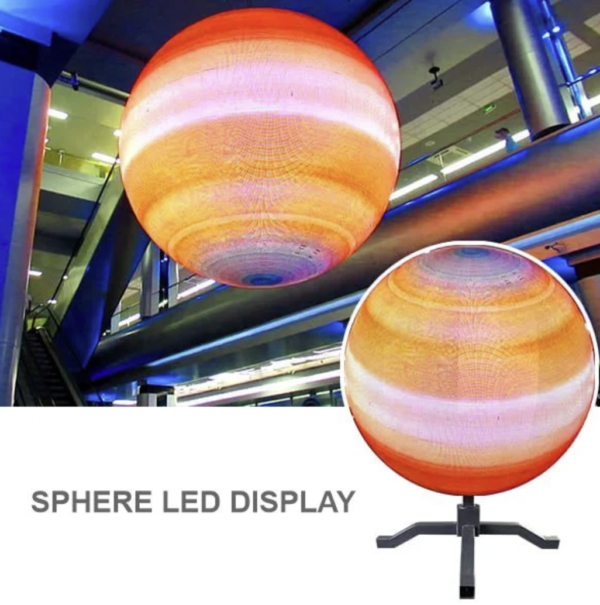
This is the part that generates support tickets. A sphere is mapped in equirectangular space — the same projection 360° VR uses — where the whole world stretches into a wide rectangle, and the poles smear across the top and bottom edges. Drop a flat 16:9 video onto the ball and two things happen: everything near the poles smears into a stretched blur, and the image tears at the meridian seam where the map closes.
Everyone in the atrium is looking at the poles. Every day.
What ships as standard: equirectangular template libraries for the atrium staples — clock faces, globes, particle fields, countdown loops, logo orbits. What is custom: your brand film adapted to the sphere, seasonal campaigns, interactive pieces. Custom spherical animation is a motion-design job with a specialist skill set, and it is the budget line venues forget until week two. Our rule after the Malaysia build: budget content the way you budget steel. If the quotation does not say who produces the content, the price is incomplete.
At handover, we run a test pattern — a grid with markers at both poles and the meridian — so the client’s content team sees exactly where the distortion zones live, and the “why does my video look bent” conversation settles in five minutes instead of five emails.
Rotation, Service, and the Specs People Skip
Rotation needs a slip ring to pass power and data through the rotating joint — a cable that twists with every revolution fatigues on a schedule you don’t choose. Bearings get sized for the real load, and balance matters more than anyone expects: an off-axis ball grinds its bearing within months. Balance the rotating mass before the ball is clad, not after. Rotation earns its cost when the ball is the show — a jewellery brand ball turning slowly above a counter buys attention no flat screen does. When the ball is signage, rotation is a maintenance line item with no return, and I will talk you out of it.
Service access: modules fail unevenly on a sphere, and the bottom band goes first — lowest in the structure, where rising heat and floor abuse (kicks, trolleys, cleaning machines) land. On a curved face every tile sits at its own angle, so extraction follows the tile’s normal: pull along the line the tile points, or you fight the neighbours and crack solder joints. The internal frame needs a service position — an access hatch or a rotatable mount that brings the working band within reach. Ask any vendor how the bottom band gets replaced before you sign; the answer tells you a lot about the rest of their engineering.
Brightness and pitch: indoor sphere class runs 800–1,500 nits — brighter on a polished floor is mostly buying glare. Viewing distance for the 1m class sits at 3–10m. Pitch forgives more on a sphere than on a wall, for a geometric reason: the eye never approaches a hanging ball head-on at 40cm the way it reads a wall screen. Curvature keeps viewers at an angle and distance, so P2.5 on a 1m ball — even P4 on a 2m landmark — disappears from view far more gracefully than the same pitch would on a wall one metre from a reader. Spend the pitch budget on size or rotation. Usually size.
The Quote Checklist: 6 Questions Before You Sign
| # | Ask | Why it matters |
| 1 | Diameter and mounting — hung or plinth, and what is the ceiling made of? | Mounting decides the steel, the rigging points and a large share of engineering cost |
| 2 | Pixel pitch for MY viewing distance? | A ball hung 12m up does not need P1.5; paying for pixels nobody resolves is the most common overspend |
| 3 | Weight and rigging points? | A 1m ball is ~450 kg — the building needs structural sign-off before the order, not after delivery |
| 4 | Is content mapping included? | Equirectangular templates or custom animation; “content not included” is a five-figure surprise |
| 5 | Maintenance access? | The bottom band fails first — front access, rotation, or a lift; how it’s serviced is the vendor’s engineering tell |
| 6 | Same-batch spares? | Tiles from a different LED batch will not color-match on a curved face; insist on same-batch spares in the contract |
Who Should Not Buy a Sphere
Three honest disqualifiers. One-directional content — a logo loop, a menu board, a campaign facing the entrance — belongs on a wall or a cylinder. A budget that crowds out the content budget produces a dark prop within a month, and a dark prop in an atrium is worse than no prop. A ball that blocks traffic — a 1.5m plinth ball in a corridor carrying strollers and trolleys is an incident report waiting to happen.
The ball earns its price when it becomes the place people agree to meet. That is a marketing decision, not a hardware one. No datasheet answers it for you.
FAQ
Does sphere content need special mapping? Yes — polar-aware, equirectangular mapping. Flat video wrapped onto the ball stretches at the equator and smears at the poles. Template content usually ships included; custom brand animation is quoted separately. Ask the supplier to state which, in writing, before you sign.
Can an LED ball hang and rotate? Both, with engineering attached. Hanging is standard on a load-rated rigging frame; rotation runs through a motorized slip-ring drive and adds cost plus one maintenance item. Specify rotation only when the ball hangs low enough for people to see the motion — and insist the mass is balanced before cladding.
How much does a 1m LED sphere weigh? Roughly 450 kg including internal steel, modules and power trunk — scaling to near a tonne at 1.5m and 1.5 tonnes and up at 2m. Treat it as a structural input: it sets the rigging points or the plinth design, and your building engineer needs it early.
What pixel pitch do I need? Use the 1-to-1 rule — minimum comfortable distance in meters roughly equals pitch in millimeters — then let the sphere’s curvature forgive you the rest. A 1m atrium ball hung 8–10m up is typically P3–P5; a 0.6m booth ball viewed at 2m wants P1.5–P2. Finer pitch than your closest viewer can resolve is money spent on nothing.
Sphere vs cylinder — how big is the price gap? For the same diameter and pitch, a cylinder usually lands at 40–60% of the sphere price: you clad a curved wall, not a full volume, with far simpler panel geometry. If your content has a dominant viewing side, the cylinder is the honest buy. The sphere premium buys exactly one thing a cylinder cannot: a screen with no back.
Get a Ball Priced Against Your Building
Send diameter, mounting, and ceiling height — we’ll price the sphere and tell you honestly if a cylinder does the job for half → Contact us