
Flexible LED Display: The Ultimate Guide (Types, Uses & Real Prices)
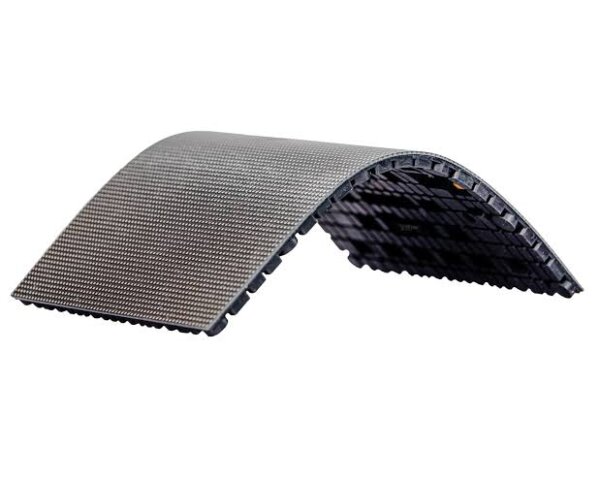
A flexible LED display is a standard LED screen built on a soft PCB with a silicone mask instead of a rigid cabinet, so it bends around columns, curves, and waves. It runs $900–1,800 per square meter FOB — about 10–30% more than a comparable flat screen — and it only earns that premium when the architecture is actually curved.
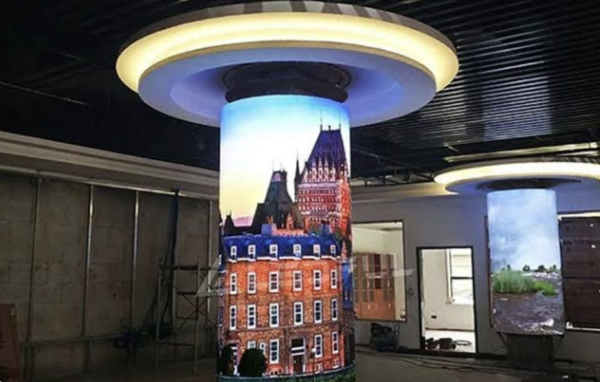
You saw it in a flagship store or a hotel lobby: video wrapped around a structural column like wallpaper, no frame fighting the curve, no black plastic box pretending to be architecture. You asked how it was made, and someone said, “flexible LED.” Then you asked what it cost, and the quotes came back at $900 per square meter from one supplier and $2,600 from another.
Neither email explained the gap. Just numbers.
Here is the claim that explains it, from the factory side: a flexible LED display is not a new technology. It is a rigid module with the rigidity removed — and every rigid element the factory takes away (the steel cabinet, the frame, the flat fiberglass board) moves a constraint somewhere else. Onto the subframe. Onto the installer. Onto the solder joints at the tightest point of the curve, four months after handover, when the dead rows start.
I know because we fixed one of those. The S-curve job shows up twice in this guide. What follows: what these modules are actually made of, the bend-radius physics that decide whether an install survives, the honest question of whether you need flexible at all, and real prices from FOB to landed.
What a Flexible LED Display Actually Is
A rigid LED module is a sandwich: LEDs and driver ICs on an FR4 board (the stiff green fiberglass core), a hard plastic mask over the face, everything bolted into an aluminum cabinet that provides structure, sealing, a heat path and service rails.
A soft LED module keeps the LEDs and the drivers and swaps the sandwich:
- Flexible PCB instead of FR4. A polyimide substrate with thinner copper bends all day without cracking. It costs more per board and moves heat worse — you pay for bendability twice, once in money, once in thermal budget.
- Silicone rubber mask instead of hard plastic. The face flexes with the board and shrugs off knocks that would crack plastic. Silicone also insulates better. File that for the heat section.
- No cabinet. Modules mount straight onto a curved subframe with magnets or screws, and the subframe inherits the cabinet’s old jobs: holding geometry, resisting sag, giving installers something to fix modules to.
Each substitution costs money and buys geometry. That is the whole trade in one line. The module is only half the product, though — the subframe is the other half, and on most projects it is yours to commission. A factory that quotes modules without asking about the subframe is quoting half a screen. Module-level specs sit on our flexible LED display product page.
First, the Honest Question: Do You Actually Need Flexible?
Most of the flexible LED inquiries we read didn’t need flexible LED. Someone saw a curve somewhere, the word “premium” did the rest, and now a straight wall is getting a bend surcharge. Run this test before you price anything:
- Wrapping an existing column or structure → yes. The geometry already exists; you’re skinning it. The textbook job, and the cheapest version of it.
- A gentle, continuous curve → yes. Concave retail walls, convex reception desks, waves. The native habitat of soft modules.
- A corner or 90-degree angle → no. Corners are rigid custom corner modules, not bent modules. Nothing folds 90 degrees without creasing traces and killing LEDs — a factory that says otherwise is quoting you a warranty claim.
- A flat wall that someone decided “curved sounds premium” → no. Buy flat and save 10–30%. A flexible screen installed flat is the most expensive flat screen money can buy.
- A sphere or ball → no. That’s sphere technology — different product, different tooling, different pricing. We built the Malaysia ball screen and wrote it up separately; a ball is not a very bendy wall.
Two yeses, three nos. On real inquiries the split runs about even — which means roughly half the people reading this just saved five figures by pausing for one page.
The Bend Radius Physics That Decide Whether an Install Survives
Bend a module and the inside of the curve compresses while the outside stretches. Copper traces and solder joints take that strain. On standard-size soft modules, below roughly a 10 cm bend radius, the solder joints on the outer edge start working loose over thermal cycles — every power-on and power-off expands each joint by a fraction of a millimeter, and fractions accumulate.
The failure we see: dead rows starting at the tightest point of the S-curve, months after install.
The S-curve job, briefly. A retail client bought cheap soft modules from a marketplace listing and installed them on a double-curve feature wall. Month four, the phone rings: rows dying. Not at random — every dead row started within centimeters of the tightest transition of the S. The modules did not fail at the average curvature. They failed at the single sharpest point, exactly where a radius spec would have said stop.
That is why the radius spec exists on every serious datasheet. And it is why “bendable” on a listing with no number attached means nothing — a bendable LED screen offered without a minimum radius is a product from a vendor who has never measured one. Ask for the number. In writing. For your actual curve.
The radius also sets the economics: a standard module bent around a tight radius won’t conform — its edges lift. So tighter radii need smaller modules, smaller modules mean more seams, and the price climbs as the radius shrinks. Not because materials get expensive — because seam count does.
| Your design radius | What it means | What to specify |
| 30 cm or more | Comfortable for any standard soft module | Choose by pitch and budget |
| 15–30 cm | Standard modules work; segmentation can read faintly on tight concave arcs | Standard modules; check mask thickness |
| 10–15 cm | The practical floor for standard soft modules | Smaller modules bend cleaner; confirm service access |
| Under 10 cm | Custom tooling territory | Modified mask profile, possibly custom PCB; longer lead time |
If your concept sits in the bottom row, send the radius before you fall in love with a timeline. For the pixel-pitch side of the decision, see our pixel-pitch guide.
Seams on a Curve Are a Different Problem Than Seams on a Wall
On a flat wall, a seam is a straight-line problem: align two edges, check the gap, done. On a column wrap, every horizontal seam is itself curved, and the eye follows the continuous surface around — so any brightness or color step between modules reads as a band that travels all the way around. The seam nobody notices on a flat video wall is the seam everybody notices on a curve.
What separates curved installs that read as one canvas from ones that look patched? Binning and calibration. Lamps from the same production batch start inside a tight wavelength-and-brightness range; then the full curve is assembled and calibrated as one canvas. Modules pulled from different batches will never quite match on a curved surface, no matter what the calibration button promises. If a vendor ships your column wrap from two batches, send it back.
Service on a Curve: The Magnet That Fights the Concave Side
Front service on a flat wall is boring: pull, magnets release, swap, push, done.
On a curve the two sides behave differently. Modules on the convex side pull off fine — the release direction points away from the wall. The concave side fights you: the magnet holds at an angle to your pull, the curve pinches the module against its neighbors, and you end up levering one off with a suction cup and some questionable vocabulary.
Design for it or pay for it later. A curved subframe should have service access built in — cutouts behind the concave runs, or tool-removable modules on that side. Magnets are faster to service and less rigid; screws hold tighter and slow every swap. Neither is wrong. Not deciding is wrong. And before you sign anything, ask the vendor to demonstrate a module swap on your curve, not on a flat demo table. If they hesitate, they have not built your install yet.
Heat: Silicone Holds Warmth More Than You’d Expect
The silicone mask insulates better than hard plastic, and curved installs usually wrap structures — concrete cores, steel columns, duct runs — with no airflow behind, because the point of the curve is to hide the structure. Heat that a flat wall would carry away sits in the modules instead. A module that measures 1,200 nits on a cold bench sits visibly dimmer at hour three of a retail day — dimmest at the deepest part of the concave section, where the heat pools. And the 70% PSU derating rule applies with less margin here: on flat, ventilated jobs we sometimes creep toward 80%; on a wrapped structure with still air behind it, we do not.
What Flexible LED Screen Price Actually Runs
Factory-direct, FOB China: $900–1,800 per square meter, set by pitch and bend radius. Tighter pitch pushes the number up; tighter radius pushes it up too, because tight bends demand smaller modules, more of them per square meter, and more assembly labor.
Ranges mean nothing until they’re multiplied. A 6 m² column wrap (2 m tall, 3 m around, P2.5) skinning an existing lobby column:
| Line item | Range |
| LED modules, 6 m² × $900–1,800/m² | $5,400–10,800 |
| Controller and receiving cards | $300–800 |
| Curved subframe and mounting, $50–150/m² | $300–900 |
| Subtotal, FOB | $6,000–12,500 |
| Landed: freight, insurance, duty, VAT | +25–40% |
| Rough landed total | $7,500–17,500 |
That $5,400–10,800 is the column wrap that replaces a printed banner cycle: a print-and-wrap runs a few hundred dollars per season; the screen runs for years and changes content daily. Payback isn’t the hard part. Specifying it right is.
And the honest comparison: a flat P2.5 screen runs $900–1,400/m². The bend premium is real — roughly 10–30% — and what it buys is geometry. The ranges overlap, which surprises buyers expecting flexible to cost double. Same LEDs, same drivers — the extra money goes into the flexible PCB, the silicone, and the seam work your curve forces. A gentle curve costs a little more than rigid; a tight one costs meaningfully more, and the difference is measured in seams, not silicon.
Budgets by Job
| Job | الحجم | الملعب | Modules, FOB | Rough landed |
| Column wrap | 6 m² | P2.5 | $5,400–10,800 | $7,500–17,500 |
| Curved retail wall | 24 m² | P2.5 | $21,600–43,200 | $30,000–65,000 |
| Exhibition sculpture | 9.4 m² | P2.5 | $8,500–17,000 | $12,500–27,000 |
| Stage curved backdrop | 40 m² | P2.5–P3 | $36,000–60,000 | $47,500–90,000 |
| Ceiling wave | 12 m² | P2.5 | $10,800–21,600 | $15,000–34,000 |
Three Types, Three Jobs
“Flexible LED” is one search term stretched over three different products. Confusing them is how people end up staring at that 900-versus-2,600 spread:
| Type | سطوع | Bend behavior | التكلفة | Best use |
| Soft silicone-mask modules | 600–1,200 nits, indoor | Two-axis, 10 cm minimum radius | $900–1,800/m² | Columns, curved walls, waves, sculptures |
| LED film / fabric | Lower; transparency is the trade | Conforms to nearly any shape | Often highest per usable pixel | Glass surfaces, ultra-thin builds |
| Curtain / rollable | Moderate; strip gaps visible up close | One-axis drape, large radii | Lowest per m² | Stages, ceilings, temporary installs |
The workhorse is the soft module — full-color video, near-rigid pixel density, serviceable if the subframe was designed by someone who has serviced one. LED film and fabric are the glass product: adhesive, ultra-thin, 60–70% transparent options for window bands — daylight does the heavy lifting, which also means film is wrong for a dim lobby, and a supplier pushing film for an interior wall is selling what they stock. Curtain and rollable variants are the big-structure product: strips that drape or roll for stages and facades, trading pixel density for coverage — the right trade when the audience stands half a plaza away.
If the design needs a sharp edge instead of a bend, that’s rigid creative territory — our creative LED display line covers the cubes and custom shapes no flexible module should attempt. And for how far curved geometry can be pushed, see the Malaysia ball screen — a sphere is a curve with no neutral side.
The Quote Checklist: Six Questions for Any Factory
- What is the minimum bend radius for my design — and is it different on each axis? Horizontal and vertical bends are not symmetric; get the number for your geometry, not a catalog figure.
- How does your module size segment my curve? Module dimensions against the arc decide whether the face reads smooth or faceted.
- Front or rear service on a curved face — and can you demonstrate the swap on my curve? Servicing a bent module is harder than a flat one; the concave side is where vendors get exposed.
- What is the brightness after bending? A measured nit figure from a bent module, not a datasheet written around a flat one.
- Magnetic or screwed mounting — and can I see the subframe drawing for my radius? The mount and the steel are where curves succeed or fail.
- Will spares come from the same production batch? Bin matching on curves is less forgiving than on flat walls; a batch change shows up as a luminance step along the arc, exactly where the eye is already looking.
That sixth question saves more projects than the other five combined. We ship 5% spares as standard; same-batch is the part that matters on a curve.
Who Should Not Buy Flexible
Three honest disqualifications. If the wall is flat, don’t — the premium buys geometry and a flat wall has none to buy. If the design is full of corners, don’t — L-shapes and 90-degree turns are corner-module jobs, and for sculptural work rigid cubes beat bends anyway; our cube guide covers why. If the screen goes outdoors, don’t — not before the IP conversation. Most soft modules are indoor animals: the silicone mask shrugs off splashes, but true outdoor duty means IP65 sealing engineered into mask, seams and subframe, sunlight-level brightness, UV-stable silicone, and a thermal plan for a module with no aluminum cabinet to dump heat into. None of that is impossible; all of it is a different quote — and for a wrapped column outdoors, we quote rigid cabinets at angles more often than not.
FAQ
What is the minimum bend radius for a flexible LED display? About 10 centimeters on standard soft modules, on either axis. Tighter than that and factories move to custom tooling — modified mask profiles, sometimes custom PCBs — which adds lead time and changes the price. If your concept needs a 5-centimeter bend, say so in the first email; it’s cheaper to hear “that needs custom tooling” on day one than after the deposit.
Can flexible LED modules be reused after an event? Yes, with discipline. Unbend them flat, store in foam with the mask protected, keep them on a flat shelf — a module that lives in its bent state takes a permanent set. Expect small attrition per cycle and budget spares for it. Same curve every time: fine. New curve every weekend: that repeated re-bending is how month-four failures get manufactured.
Can a flexible LED screen go outdoors? Rarely the right call. No cabinet means no IP rating to inherit — sealing has to be engineered into the mask, seams and subframe, UV ages silicone, and there’s no aluminum heat sink. Outdoor film and mesh products exist for facades; for wrapped columns outdoors, rigid cabinets at angles usually win the quote.
How is content mapped onto a curved surface? The modules still address as one rectangular canvas — the curve is physical, not digital. Content is authored flat and the geometry wraps it; for as-built precision, the installation drawings become a pixel map of actual positions, and test patterns run across the full curve before handover. On concave walls the viewer never sees the join.
Flexible vs rigid LED screen price — how big is the gap? Roughly 10–30%. Flat P2.5 runs $900–1,400/m²; flexible lands at $900–1,800/m² FOB once pitch and radius are set. The gap narrows on large gentle curves and widens on tight-radius fine-pitch work. Add subframe and mounting to both sides before judging — rigid needs structure too. And on a flat wall the gap is total.
Send Us the Curve
Geometry decides everything on this page — module size, seam count, price, even which technology you should buy. Send the curve — radius, size, what it wraps — and we’ll tell you the honest technology, even when the answer is rigid.