
Vehicle-Mounted LED Display Buying Guide 2026: Taxi Top vs Rear Window vs Body Screen
Reading time: ~15 min | Best for: Fleet operators, outdoor advertising agencies, taxi cooperatives, DOOH media buyers evaluating mobile LED advertising formats.
The 60-second version
If you are putting digital screens on vehicles, the format decision tree is simpler than suppliers make it sound:
| Your situation | Recommended format | Typical unit cost (FOB China) |
| City taxi fleet wants to sell ad space to local businesses | Taxi-top dual-sided LED | 280–580/unit |
| Uber/Lyft/delivery vehicles, thin is critical, private drivers | Rear window LED | 120–350/unit |
| Truck fleet, high-impact branding, large viewing area | Truck body/side LED panel | 600–2,200/unit |
| Bus fleet, public transit, wrap-around visibility | Bus LED display | 800–3,500/unit |
| Event marketing, one-off campaigns, trade shows | Mobile LED trailer/truck | 12,000–45,000/unit |
The right format is not the one with the highest pixel density or the brightest LEDs. It is the one whose revenue model, installation constraint, and maintenance path match your operation. This guide compares all four mainstream vehicle-mounted LED formats across the six dimensions that determine whether a screen pays for itself or collects dust.
We manufacture taxi-top, rear-window, and truck-body LED displays from our Shenzhen production line. This guide reflects what we have learned from 700+ fleet deployments across 20+ countries — including the things that go wrong when you pick the wrong format.
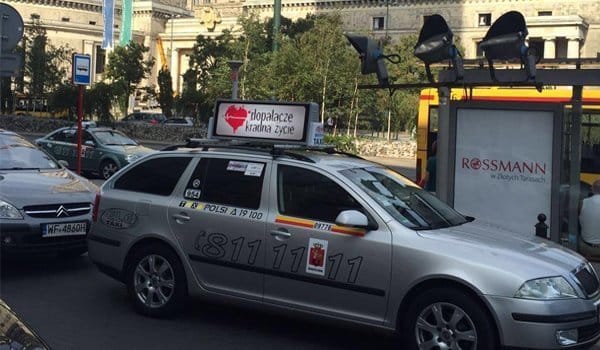
Why Vehicle LED Advertising Is Growing Faster Than Static Billboards
Vehicle-mounted digital screens are not a new idea. Taxi tops with scrolling text have existed since the early 2000s. What changed in the last three years — and what makes 2026 a fundamentally different market—are three things:
1. 4G module prices collapsed. A reliable 4G module with GPS cost 35–50 in 2020. It costs 8–15 in 2026. This single component cost reduction is what made remote content management affordable for fleets of any size. You no longer need a technician with a laptop and a USB cable to update ad content. You update it from a phone.
2. LED brightness per watt doubled. Modern flip-chip and CSP LED packages deliver roughly twice the brightness per amp at the same price point compared to 2020. A 2026 P5 taxi-top display runs at 5,500+ nits while drawing 15–20% less power than a 2020 equivalent. Lower power draw means less strain on the vehicle alternator, fewer battery-related failures, and a longer practical operating lifespan.
3. Programmatic DOOH arrived. Digital out-of-home (DOOH) advertising is now programmatically tradable in 40+ markets, meaning advertisers can buy impressions on vehicle screens the same way they buy Facebook ads—through a platform, in real time, with targeting. A taxi-top fleet connected to a programmatic network can serve different ads by time, location, and even weather conditions, commanding CPM rates 3–5x higher than static campaigns.
The result: vehicle LED advertising is one of the few out-of-home formats still growing in both impressions and revenue per screen. But the format you pick determines whether you capture that growth or get stuck with screens nobody wants to advertise on.
Format Comparison: Taxi Top vs Rear Window vs Body Screen at a Glance
Before we dive into each format, here is the side-by-side comparison across the six dimensions buyers actually care about:
| Dimension | Taxi Top LED | Rear Window LED | Truck Body LED | Bus LED |
| Typical size | 960×280–400mm | 700–1,200×150–250mm | 1,200–4,800×400–960mm | 1,200–3,600×280–400mm |
| Viewing distance | 10–50m | 3–15m | 15–100m | 10–50m |
| Brightness | 4,500–6,000 nits | 3,500–5,000 nits | 5,500–8,000 nits | 5,500–7,000 nits |
| Pixel pitch range | P3.33–P5 | P2.0–P3.33 | P5–P10 | P5–P6 |
| Power draw (12V) | 40–80W | 25–50W | 200–800W | 150–400W |
| Weight | 12–18 kg | 1.5–4 kg | 25–60 kg | 22–50 kg |
| Installation time | 30–60 min | 5–15 min | 2–6 hours | 4–12 hours |
| Vehicle requirement | Roof rack + 12V | Glass adhesion or bracket | Structural frame + 24V | Body bracket + 24V |
| Content flexibility | High (dual-sided) | Medium (one-sided) | High (large canvas) | High (long format) |
| Revenue model | CPM impressions, monthly slots | Route-based sponsorship | Brand campaigns, per-route | Transit advertising network |
| Maintenance access | Easy (roof-accessible) | Moderate (glass removal) | Hard (ladder/scaffold) | Moderate (depot access) |
| Regulation risk | Medium (some cities ban) | Low (considered accessory) | Low (commercial vehicle) | Low (public transit) |
| Unit cost (FOB) | 280–580 | 120–350 | 600–2,200 | 800–3,500 |
Now let’s break down each format in detail.
Format 1: Taxi Top LED Display — The Fleet Revenue Engine
What it is
A dual-sided LED screen mounted on the roof of a taxi or ride-hail vehicle. The standard form factor is approximately 960mm wide × 280–400mm tall with LED faces on left and right (and sometimes the rear). Power is drawn from the vehicle’s 12V system. Content is managed remotely via 4G/Wi-Fi.
Where it works
- City taxi fleets with 50+ vehicles running 10–18 hour daily shifts
- High-impression urban routes (downtown, shopping districts, airports)
- Markets where taxi advertising is already an established DOOH category (Southeast Asia, Latin America, Middle East, Africa)
- Fleet operators who plan to sell ad space directly or through a media agency
Where it fails
- Small fleets (<20 vehicles). Advertisers buy reach, not individual screens. A 15-vehicle fleet cannot deliver enough daily impressions to justify a media buyer’s time.
- Rural or highway routes. Taxi tops need slow urban traffic to generate impressions per vehicle per hour. A highway taxi at 100 km/h generates almost zero readable impressions.
- Cities with taxi-top advertising bans. Several cities (parts of Europe, some US metro areas) restrict or ban roof-mounted commercial signage. Check local regulations before purchasing.
What it actually costs
| Item | Budget option | Mid-range | Premium |
| Hardware (per unit, P5 dual-sided) | 280–350 | 380–480 | 500–580 |
| Installation (per unit) | 25–60 | 60–100 | 100–150 |
| Mounting bracket + wiring harness | 30–50 | 50–80 | 80–120 |
| 4G data plan (per unit/month) | 2–5 | 5–8 | 8–12 |
| Content management platform (monthly, fleet) | 30–80 | 80–200 | 200–500 |
| Spare modules (5% recommended) | 15–25/unit | 20–40/unit | 25–50/unit |
Fleet cost example—100 units, mid-range P3.33:
| Cost category | Amount |
| 100 × P3.33 dual-sided | $42,000 |
| Installation (100 × $80 avg) | $8,000 |
| Mounting kits (100 × $65) | $6,500 |
| First-year data (100 × $6 × 12) | $7,200 |
| CMS platform (annual) | $1,200 |
| Spare modules (5%) | $1,800 |
| Shipping (40-ft container, estimate) | 3,500–5,500 |
| Import duties (varies by country) | 0–25% |
| Total first-year investment | 70,200–85,000 |
Revenue potential
Taxi-top ad revenue varies dramatically by city, but here are ballpark figures from actual deployments:
| Market tier | Monthly revenue per screen | Payback period | Notes |
| Tier 1 (Bangkok, São Paulo, Lagos, Jakarta, Cairo) | 80–180 | 6–10 months | Dense traffic, established DOOH buying habits, high daily impressions |
| Tier 2 (secondary cities in same countries) | 40–80 | 10–16 months | Good traffic, smaller ad budgets, more local advertisers |
| Tier 3 (smaller cities, new markets) | 15–40 | 18–30 months | Fewer impressions, advertisers need education, lower fill rates |
The critical variable is ad sales capability, not screen quality. A fleet operator with an in-house ad sales team (or a contract with a media agency) will fill 70–90% of inventory. A fleet operator who “plans to find advertisers later” will fill 20–30% and lose money on the hardware. The revenue model matters more than the pixel pitch.
For a deeper dive into taxi-top specifications, brightness, IP ratings, and 4G control systems, read our dedicated taxi-top LED buying guide.
Format 2: Rear Window LED Display—The Thin, Rideshare-Friendly Alternative
What it is
A slim LED panel mounted inside the rear window of a vehicle, facing outward. Typically 700–1,200mm wide and 120–250mm tall, with a thickness of 15–30mm. The ultra-thin form factor is the defining design constraint—it must not obstruct the driver’s rearview visibility and must fit within the curvature of a standard rear windshield.
Rear window displays are the fastest-growing vehicle LED category in 2026, driven by three trends:
- Rideshare explosion. Uber, Lyft, Didi, Grab, and local rideshare equivalents have created a fleet of millions of private vehicles that spend 8–14 hours daily on high-impression urban routes. These are not taxis — they are private cars whose owners are open to earning extra revenue.
- Thinness breakthroughs. PCB-on-glass and flexible substrate LED modules now achieve 12–18mm total panel thickness, which fits within the rear windshield cavity of most sedans and SUVs without blocking the driver’s rearview mirror.
- Suction-cup and adhesive mounting. Unlike taxi tops that require permanent roof-rack installation, rear window displays use suction cups or 3M adhesive strips that install in minutes and leave no permanent modification. This is critical for rideshare drivers who lease or finance their vehicles.
Where it works
- Rideshare drivers (Uber, Lyft, regional equivalents) who want passive ad income
- Delivery fleets (food, parcel) making 20–50 stops per day in urban neighborhoods
- Private car owners in gig-economy markets
- Markets where taxi-top screens face regulatory restrictions but rear window screens do not
Where it fails
- Vehicles with heavily tinted rear windows. If the window film blocks more than 30% of light transmission, the display will be unreadable during daylight.
- Sedans with small, steeply raked rear windows. The display needs at least 120mm of vertical glass to mount securely and maintain visibility.
- Markets where rear window obstructions are regulated. Some jurisdictions require an unobstructed rearview path. Check local vehicle codes.
What it actually costs
| Item | Budget | Mid-range | Premium |
| Hardware (per unit, P3.33, 960×200mm) | 120–180 | 200–280 | 300–350 |
| Mounting (suction cups or adhesive) | Included | Included | Included |
| 4G + GPS module | 15–25 | 20–30 | 25–35 |
| Power cable (12V cigarette lighter or OBD) | 5–10 | 10–15 | 15–20 |
| Content management app (per unit/month) | Free–$3 | 3–5 | 5–8 |
Driver economics — 1 unit:
| Monthly | |
| Revenue (local ads, 60% fill rate, Tier 1 city) | 40–80 |
| 4G data | 3–6 |
| Content platform fee | 0–5 |
| Net monthly income per unit | 30–75 |
| Hardware payback | 3–6 months |
The rear window format’s economics are fundamentally different from taxi tops. The hardware is cheaper (120–350 vs 280–580), but the revenue per screen is also lower because the display area is smaller and one-sided. The financial case works because the payback period is short (3–6 months) and the driver’s risk is minimal — if ad sales dry up, the screen cost is already recovered.
Key specification differences vs taxi tops
| Spec | Taxi top | Rear window | Why it matters |
| Thickness | 60–120mm | 12–30mm | Must fit behind glass, not block rear view |
| Weight | 12–18 kg | 1.5–4 kg | Suction cups cannot support heavy units |
| Brightness | 4,500–6,000 nits | 3,500–5,000 nits | Tinted glass reduces effective brightness |
| Pixel pitch | P3.33–P5 | P2.0–P3.33 | Viewers are closer (3–15m vs 10–50m) |
| Power | 12V direct wire | 12V cigarette/OBD | Plug-and-play for rideshare drivers |
| Installation | Permanent bracket | Suction cup/adhesive | No vehicle modification |
The rear window format’s biggest risk is not technical—it is ad sales aggregation. A single driver with one screen cannot sell ads. The model works when a platform aggregates hundreds or thousands of drivers, sells impressions to advertisers, and distributes revenue. Without an aggregator, rear window screens are just blinkenlights. With one, they become an automated passive-income machine.
Format 3: Truck / Vehicle Body LED Panel — The Mobile Billboard
What it is
A large-format LED panel permanently mounted to the side or rear of a truck, trailer, or commercial vehicle. Typical sizes range from 1.2m × 0.5m (small panel) to 4.8m × 1.0m (full trailer side). This is the heavy-duty format — high brightness, high power draw, structural installation, and the largest ad canvas of any vehicle-mounted LED type.
Unlike taxi tops (which are double-sided city screens) and rear window displays (which are thin accessory screens), truck-body panels are closer to outdoor billboards on wheels. They are typically used for three purposes:
- Fleet self-promotion. A logistics company puts its own branding and dynamic messaging on its trucks. No ad sales required — this is a marketing cost, not a media product.
- Route-based advertising. A dedicated mobile billboard truck drives predetermined routes and sells ad space to brands by the day, week, or campaign.
- Event and brand activation. A branded truck parks at events, stadiums, or retail locations and serves as a mobile digital billboard.
Where it works
- Logistics fleets (trucking, delivery, distribution) that own their vehicles and want to monetize exterior space
- Mobile billboard operators running routes in high-traffic urban corridors
- Brand activation agencies that need a mobile digital canvas for events and campaigns
- Markets with wide, straight roads and high truck traffic visibility (highways, industrial zones, port areas)
Where it fails
- Narrow city streets where trucks cannot maneuver or park
- Routes with low truck visibility (tunnels, dense urban canyons, tree-lined roads)
- Fleets where trucks are frequently repainted, reskinned, or reassigned to different routes without notice
What it actually costs
| Item | Budget | Mid-range | Premium |
| Hardware (per m², P6–P10 outdoor) | 400–650/m² | 700–1,000/m² | 1,100–1,600/m² |
| Typical panel size | 1.5–3 m² | 3–6 m² | 6–12 m² |
| Typical unit cost | 600–2,000 | 2,100–6,000 | 6,600–19,200 |
| Structural mounting frame | 150–400 | 400–800 | 800–2,000 |
| Installation (per truck) | 200–500 | 500–1,200 | 1,200–3,000 |
| Power system (24V converter, alternator upgrade if needed) | 100–300 | 300–600 | 600–1,200 |
| Content management (annual) | 200–500 | 500–1,200 | 1,200–3,000 |
Real-world project example — 10-truck logistics fleet, mid-range P6, 4 m² per truck:
| Cost category | Amount |
| 10 × 4 m² × $850/m² | $34,000 |
| Mounting frames (10 × $600) | $6,000 |
| Installation (10 × $850) | $8,500 |
| Power upgrades (10 × $450) | $4,500 |
| CMS annual | $800 |
| Spare modules & parts | $3,000 |
| Total project cost | $56,800 |
Revenue potential
Truck-body advertising is typically sold by the day, week, or month — not by CPM impressions like taxi tops. The pricing is closer to outdoor billboard rates, adjusted for the mobility advantage:
| Campaign type | Revenue per truck per month | Who buys it |
| Fleet self-promotion | $0 (cost center) | The fleet owner |
| Route-based brand campaign | 800–2,500 | FMCG, telecom, event promoters |
| Event activation (per day) | 500–1,500 | Brands at concerts, sports, festivals |
| Government / public service | 300–800 | Municipal campaigns, health awareness |
The key variable is route quality. A truck that drives a high-traffic urban loop (8 hours/day, 100,000+ daily impressions) commands premium rates. A truck that runs long-haul highway routes generates negligible impressions and should only carry the fleet operator’s own branding.
Power and installation realities
Truck-body panels cannot run on a standard 12V cigarette lighter. They require:
- 24V power conversion (standard on commercial trucks; may need a DC-DC converter for 12V systems)
- Alternator capacity check—a 4 m² panel drawing 400–600W adds significant load. Most heavy trucks handle this; light trucks may need an alternator upgrade.
- Structural mounting—the panel must be bolted or welded to the vehicle frame, not the body panels. Body panels flex and vibrate independently of the frame, and mounting LED modules to a flexing surface guarantees early failure.
- Weatherproofing at highway speed—the cabinet must resist wind-driven rain at 80–120 km/h and the associated vibration. IP66 is the practical minimum for highway trucks; IP65 is designed for stationary installations.
Format 4: Bus LED Display — The Public Transit Canvas
What it is
LED panels mounted on the rear, side, or front of public transit buses. The form factor is typically long and narrow — 1,200–3,600mm wide × 280–400mm tall — optimized for the horizontal lines of a bus body.
Bus displays share most of their engineering DNA with truck panels (high brightness, 24V power, structural mounting) but differ in three ways:
- Predictable routes. Buses run fixed routes on fixed schedules. Advertisers know exactly where and when their ads will be seen, which makes bus advertising easier to sell than taxi advertising.
- Transit authority ownership. The bus operator (typically a municipal transit authority) owns both the vehicle and the ad inventory. The LED hardware is purchased by the transit authority or leased from an advertising concessionaire.
- Higher durability requirements. Transit buses operate 16–20 hours/day, seven days a week, with minimal downtime for maintenance. The screens must be essentially maintenance-free for years at a time.
What it costs
Bus displays are the most expensive vehicle-mounted format per unit, but they are almost always deployed in small quantities (1–2 per bus, not per fleet of thousands).
| Item | Range |
| Hardware (per unit, P5–P6, rear-mount) | 800–2,500 |
| Hardware (per unit, side-mount, 3–4m long) | 2,000–3,500 |
| Installation (per bus) | 400–1,500 |
| Power integration (24V bus system) | 200–500 |
When to recommend bus displays
Only when the buyer is a transit authority, an advertising concessionaire with an existing transit contract, or a system integrator bidding on a municipal tender. Bus LED displays are not a retail product — they are a municipal infrastructure purchase with public procurement timelines, tender requirements, and multi-year service contracts.
Head-to-Head ROI Comparison: Which Format Pays Back Fastest?
Here is the financial comparison for a fleet operator deploying 100 units in a Tier 1 emerging-market city (think Bangkok, São Paulo, Nairobi):
| Metric | Taxi Top (100 units) | Rear Window (100 units) | Truck Body (10 trucks) |
| Initial investment | 70,000–85,000 | 16,000–25,000 | 50,000–65,000 |
| Monthly ad revenue | 8,000–15,000 | 3,000–7,000 | 8,000–20,000 |
| Monthly operating cost | 1,500–2,500 | 500–1,000 | 1,500–3,000 |
| Monthly net | 5,500–13,000 | 2,000–6,500 | 5,000–18,500 |
| Payback period | 6–15 months | 3–7 months | 4–13 months |
| 5-year net revenue | 310,000–760,000 | 105,000–375,000 | 265,000–1,050,000 |
| Screen lifespan | 3–5 years | 2–4 years | 4–7 years |
| Scalability | High (add taxis) | Very high (add drivers) | Low (trucks are expensive) |
| Operational complexity | Medium | Low | High |
What the numbers do not show:
- Rear window has the fastest payback but the lowest ceiling. You cannot scale rear window revenue per screen because the display area is small and one-sided. This is a volume play—1,000 screens generating $40/month each.
- Taxi top is the balanced option—good revenue per screen, proven ad sales model, manageable complexity.
- Truck body has the highest absolute revenue potential but the highest operational burden. Power issues, installation complexity, and maintenance access are real-world headaches that do not appear on a spreadsheet.
Four Critical Factors Most Buyers Overlook
1. Power: Vehicle electrical systems were not designed for LED displays
This is the number one source of “my screen died” support calls. Vehicle electrical systems fluctuate wildly—11.5V to 14.8V on 12V systems, spikes during engine start, voltage drops under heavy load. A cheap LED display with a basic voltage regulator will die within months. A quality display has:
- Wide-input DC-DC converter rated for 9–36V (covers 12V and 24V systems with margin)
- Reverse polarity protection (prevents instant death from a reversed power cable)
- Surge suppression (protects against voltage spikes when the engine starts or the alternator kicks in)
- Low-voltage cutoff (turns off the display before battery drain prevents engine start)
Question to ask your supplier: “What is the input voltage range, and does it include reverse polarity protection and surge suppression?” If they cannot answer, the power supply design is not vehicle-grade.
2. Vibration: Bench tests mean nothing
A display that works perfectly on a factory bench will fail on a vehicle within months if the internal connectors are not vibration-rated. The specific failure points:
- Module-to-hub board connectors. Standard pin headers work loose under road vibration. Locking connectors or soldered connections are mandatory.
- Power supply mounting. Screw-mounted PSUs vibrate loose over time. Thread-locking compound or spring washers are essential.
- Cabinet screws. Every external screw on a vehicle display should have a nylon locking ring or thread locker. Otherwise, the display will literally unscrew itself over 50,000 km.
Question to ask your supplier: “Have these displays been vibration-tested? For how many hours and at what frequency and amplitude?” If they have no test data, they are selling you an indoor display in an outdoor-rated cabinet on a vehicle it was never designed for.
3. Heat: The roof is the hottest place on the car
A taxi roof in summer, direct sun reaches 65–80°C surface temperature. Inside a black LED cabinet with no ventilation, internal temperatures can exceed 90°C. LED brightness drops roughly 1% per °C above 25°C. At 85°C internal temperature, your screen is running at 60% of its advertised brightness—on the day you need it most.
The solutions that quality manufacturers build in:
- Aluminum cabinet (not steel) — dissipates heat 3x faster
- Active ventilation — small, weatherproofed fans or vent channels
- Temperature-based brightness throttling — automatically reduces brightness to protect LED lifespan when internal temps exceed safe thresholds
- High-temperature-rated components — electrolytic capacitors rated for 105°C (not 85°C), automotive-grade connectors
4. Content management: The software matters as much as the hardware
A vehicle LED display without a functional content management system (CMS) is just a very expensive light. The CMS must do at least these things:
- Schedule ads by time and day. Different advertisers for the morning commute, lunch hour, and evening rush.
- Geo-fence content. Show different ads in different parts of the city based on GPS location.
- Update over 4G. No USB drives, no laptops, no technician visits.
- Report impressions. Prove to advertisers that their ads actually ran, when and where.
- Handle multiple ad slots. Rotate through 4–8 advertisers per screen with timed slots and automated billing.
- Monitor screen health. Alert the fleet manager when a screen is offline, has dead pixels, or shows abnormal power draw.
Question to ask your supplier: “Can you show me the CMS dashboard in a live demo—not screenshots, a working screen?” If they cannot schedule content by time slot and geo-fence, the platform is not production-ready.
For more on content management, see the CMS section in our taxi-top LED guide and our LED display moisture protection guide for the environmental protection side.
Which Format Should You Pick? A Decision Framework
Use this flowchart logic, not a spec sheet comparison:
- Are you a fleet operator who sells ad space? → Taxi top. Proven ad sales model, manageable hardware, decent margins.
- Are you a rideshare aggregator or platform? → Rear window. Lowest barrier to entry, fastest scaling, but requires aggregation to sell ads.
- Are you a logistics company that wants to monetize truck exteriors? → Truck body. Large canvas, high revenue potential, but complex installation and maintenance.
- Are you a single vehicle owner or small fleet (under 20 vehicles)? → Rear window. Shortest payback, lowest financial risk, no permanent vehicle modification.
- Are you bidding on a transit authority tender? → Bus display. Municipal procurement process, long sales cycle, high barrier to entry.
- Are you planning a one-off event activation? → Rent a mobile LED truck. Do not buy hardware for a single campaign.
Eyecatchmedia Vehicle LED Display Product Lines
We manufacture three of the four vehicle-mounted LED formats covered in this guide, plus mobile LED trailers for event applications.
| Product line | Pixel pitches | Features | Learn more |
| Taxi Top LED | P5 / P3.33 / P2.5 | Dual-sided, 4G+GPS, IP65, 12V, 3yr warranty | Taxi top buying guide → |
| Rear Window LED | P2.5 / P3.33 | 12–18mm thin, suction mount, P2.5 for close view, 4G+GPS | Contact us for specs → |
| Truck Body / Bus LED | P5 / P6 / P8 / P10 | IP66, aluminum cabinet, 24V, structural frame included, anti-vibration connectors | Request a quote → |
| Mobile LED Trailer | P3.91 / P4.81 / P6 | Self-contained trailer, generator or battery, hydraulic lift, turnkey event solution | Explore mobile LED → |
Every vehicle display we ship includes:
- Wide-input DC-DC converter with reverse polarity protection and surge suppression
- Vibration-rated locking connectors (not friction-fit pin headers)
- Temperature-based brightness throttling with 105°C-rated components
- 24-hour minimum per-panel aging test
- 4G/Wi-Fi module + GPS + web-based CMS (ledaips.com)
- CE, FCC, RoHS certification
- 3-year warranty + 5% spare modules
If you are comparing quotes, use the 8-question procurement checklist in our spec traps guide. The same principles apply to vehicle displays — the difference is that vehicle deployments add vibration, heat, and power quality to the list of things that can go wrong.
FAQ: Vehicle LED Display Questions from Real Buyers
Q: How much ad revenue can I realistically expect per taxi-top screen?
A: In a Tier 1 emerging-market city (dense traffic, established DOOH media buying): 80–180/month per screen at 60–80% fill rate. In a Tier 2 city: 40–80/month. This assumes you have an ad sales mechanism — either your own sales team, a media agency partner, or a programmatic DOOH platform. Without ad sales, the revenue is $0 and the screens are a liability. Revenue depends on ad sales capability, not hardware quality.
Q: Do I need a programmatic DOOH platform to sell taxi-top ads?
A: Not necessarily to start, but it helps. Many fleet operators begin by selling monthly ad slots directly to local businesses (restaurants, car dealerships, real estate agents) through a simple rate card. Once you have proven impression data from your first 50–100 screens, you can connect to a programmatic exchange. Direct sales are simpler, programmatic is more scalable.
Q: Can I install a rear window screen myself?
A: Yes — that is the entire point of the format. Rear window displays ship with suction cups or 3M adhesive strips, plug into the 12V cigarette lighter or OBD port, and require zero vehicle modification. Installation takes 5–15 minutes. The skill requirement is “can you stick a phone mount to a windshield.” No tools needed.
Q: Will the rear window screen block my rearview mirror?
A: A properly sized rear window display (150–200mm tall, mounted at the top of the rear window) leaves the lower 60–70% of the rear window unobstructed. You can still see traffic through the rearview mirror. However, this depends on the vehicle’s rear window dimensions—sedans with small, steeply raked windows may have insufficient clearance. Measure before ordering.
Q: How long do vehicle LED displays actually last?
A: With proper components and maintenance: taxi tops 3–5 years, rear window 2–4 years, truck body 4–7 years. The actual lifespan is determined by three things: LED chip quality (gold-bin vs economy-bin), power supply quality (Mean Well vs no-name), and environmental protection (conformal coating vs bare PCB). The spec sheet says “100,000 hours LED lifespan”—that is the theoretical LED chip lifespan in a laboratory, not the practical screen lifespan on a vehicle. Our spec traps guide explains what spec sheet numbers actually mean.
Q: What certifications do I need for vehicle LED displays?
A: CE (Europe), FCC (US), and RoHS (environmental) are the baseline. For vehicle-specific certification, E-Mark (ECE R10) is required in Europe and many countries that follow EU vehicle standards for aftermarket electrical equipment installed on vehicles. Some markets also require local wireless certification for the 4G/GPS module. Always confirm certification requirements with your local importer or customs broker before ordering.
Q: Can taxi-top screens run on electric vehicles?
A: Yes, but it depends on the EV’s 12V auxiliary system. Most EVs have a 12V accessory battery (separate from the high-voltage traction battery) that powers lights, infotainment, and accessories. A taxi-top display drawing 40–80W on 12V is well within the capacity of a standard EV auxiliary system. However, check with the vehicle manufacturer — some EVs have surprisingly low auxiliary power budgets, and tapping into the 12V system may void the warranty.
Q: What pixel pitch do I need for a truck-body display viewed from highway distances?
A: P8 or P10. At highway viewing distances (30–100 meters), a P10 display at 5,500+ nits with good contrast ratio is perfectly readable. P6 is visually sharper but costs roughly 40–60% more per square meter and consumes more power. For truck applications where the canvas is large (4+ m²) and the viewing distance is long, P8 or P10 is the cost-effective choice. Reserve P5–P6 for urban trucks on slow routes where viewers are closer.
This article is part of Eyecatchmedia’s LED display procurement guide series. For more buying guides covering indoor/outdoor LED displays, rental screens, transparent displays, and COB vs SMD technology, visit our resources page.
Deploying vehicle LED displays? Contact Eyecatchmedia for a full-BOM quote with vibration-rated connectors, wide-input power systems, and a live CMS demo—delivered within 24 hours.