
LED Cube Display: Sizes, Uses & Real Prices (2027 Factory Guide)
A standard 500mm five-face LED cube display costs $600–1,400 FOB Shenzhen, depending on pitch — the same style of unit retails at A$1,760–7,348 in Australia. Compact 320–400mm cubes run $400–700 factory-direct; custom builds past 800mm start at $1,800–4,000+. This guide breaks down what those numbers buy, the corner engineering that explains quote gaps, and when a cube earns its premium over a flat wall.
You saw one somewhere — a museum lobby, a TV set, a clip doing numbers on Instagram — and went looking for the price. Then you hit the mess: search “led cube screen,” and you meet two markets pretending to sell the same object. Chinese factory listings sit around 405–450 for a compact unit. Australian retailers: near-identical magic cube LED display at A$ 1,760–7,348, including GST.
Same object. Ten times the price.
Neither listing is lying — they are selling different amounts of engineering. The factory number buys bare hardware: modules, frame, power supplies, a receiving card, a wooden crate. The retail number buys the same hardware plus freight, duties, a local warranty, an installer who answers the phone, and the margin that keeps a showroom lit. That is a supply chain, not a scam on either side.
We build these on a factory floor. Our work in this family includes the LED cubes for a Whitney Museum exhibition in New York, an LED ball screen for Malaysia, and a 3D naked-eye display for Nepal — part of our creative LED display line, where geometry, not raw resolution, is the product. This guide is the pricing conversation we have every day, written down once.
What You Are Actually Buying
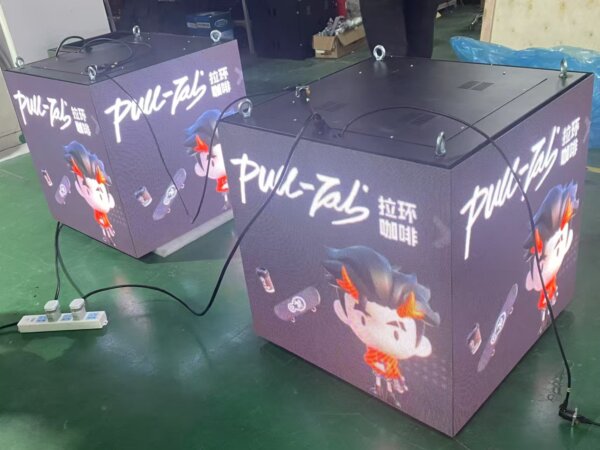
An LED cube display is a self-supporting screen built from four or five LED faces joined into a box and driven as one canvas. Four faces when it stands on the floor — no bottom, usually no top. Five when it hangs, sits on a low plinth, or rotates. Vendors also sell the same construction as a 3D LED cube; ignore the labels and read the spec.
One distinction worth making before anything else, because buyers conflate it constantly: a true cube shows real 3D volume — you walk around it. A 3D naked-eye screen fakes depth on a flat surface through forced perspective, which is what our Nepal installation does. Both get marketed as “3D LED.” Only one is a cube.
Four decisions drive every quote:
Size. Faces snap to LED module multiples, which is why catalogs repeat the same numbers: 320, 384, 480, 500, 512, 576, 800mm. A 320mm cube fits on a plinth; a 1m cube is furniture — two people to move, used-car money to buy.
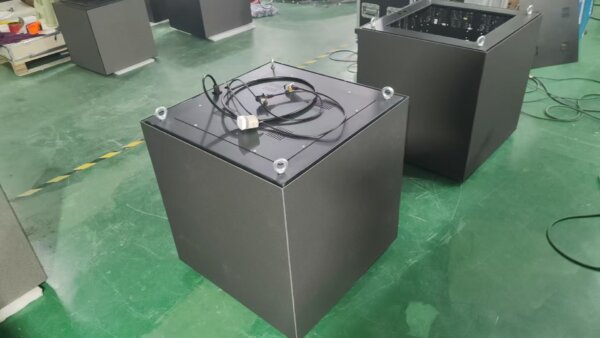
Faces. Four faces with open top and bottom is the standard build, and usually the right one — nobody sees the bottom, and dropping unused faces cuts cost and weight. Five faces pay back when the cube hangs, sits low enough that visitors look down at it, or anchors a broadcast set where a jib camera sees the top. Our most common real inquiry says it plainly: “4 sides, no bottom, no top, indoor, P2.5 or finer, 50cm+, quote with shipping.”
Pitch. Cubes are watched closer than almost any LED format — the audience chooses its own distance, and it chooses 40 cm. At that range pitch does more work than it does on a wall: P2.5 or finer for anything near people, P3–P4 when the cube hangs above head height or sits behind a rope. A 500mm face holds 200×200 pixels at P2.5 versus about 166×166 at P3 — that LED count is why fine pitch jumps the price a third.
Environment. Indoor cubes run 600–1,200 nits. Outdoor demands IP65 sealing, drainage, and 4,500–6,500 nits to fight daylight, adding 15–25% to the build. If yours might ever go outside, say so on day one — waterproofing cannot be retrofitted.
Then the three options that surprise buyers:
- Rotation, +$200–500: a motorized base with a slip ring carrying power and data through the moving joint. Worth it in retail windows. Overkill in a fixed corner.
- Hanging rigging, +$80–150 per unit: fly bars and safety hardware. The venue’s structural sign-off is on you, not the factory.
- Custom branding on the frame: powder-coated steel in a brand color. Trivial if specified before production; expensive if asked for after shipping.
LED Cube Price: 2027 Factory Ranges
Market-median figures, FOB Shenzhen, single unit, small quantity:
Add-ons: rotation +200–500|IP65outdoor+15–2580–150.
Land them before you budget: sea freight, insurance, duties and delivery add 25–40% over FOB. A $700 cube costs $875–980 at your door. The $405 factory listing from the hook lands near $510–570 — still a fraction of the retail price, because what you cannot shop away is service, not hardware.
To anchor the brackets: $400–700 is dinner for four. $900–1,400 is a decent laptop. $1,800–4,000+ is a sculpture that plays video.
One opinion we hold firmly: if a quote doesn’t state faces and pitch separately, it’s hiding something. “500mm cube, P3” and “500mm cube” are different products with a $300–400 gap between them.
Budget by Buyer Type
Two patterns from our order book: museums settle at P2.5 and buy in twos and threes; nightclubs order coarse pitch and large bodies. Nobody famous ever bought the average.
The Engineering That Explains Quote Gaps
A cube looks like five panels screwed together. It is not — and the difference is exactly what you are paying for.
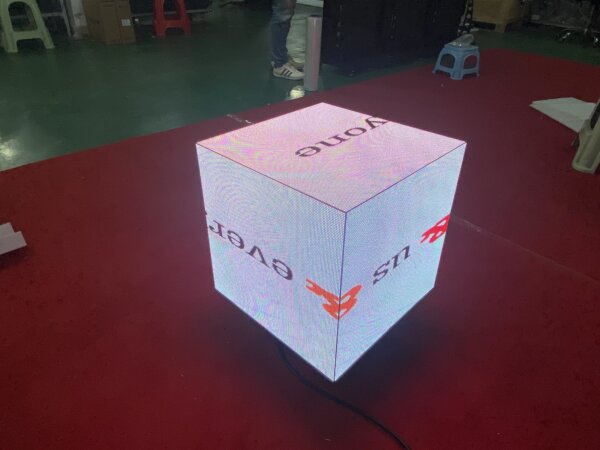
Corners are the product. A flat wall has one job: stay flat. A cube has twelve edges, and at every corner three planes meet at a point — with your visitors standing close enough to inspect the junction. Factories handle this two ways. Custom-bent corner modules keep the seam away from the apex and hold pitch true through the bend; they cost tooling money up front. Butt joints with filler strips — what the $405–450 listings sell — work from two meters, but at 40 cm the strip reflects light differently from the module surface, and the corner reads like a budget hotel bathroom: decent tile, wrong grout. Tolerance stacking makes it worse: a cabinet holds flatness within ±0.3–0.5 mm, five faces accumulate the error at the worst corner, and I have measured 1.5–2 mm steps on competitor units — enough to catch a fingernail in, and it photographs.
A properly cornered cube costs roughly 30% more than the panel math suggests. Yes — because it is not five flat panels. The corner modules, the frame that holds five faces in register over years of thermal cycling, and roughly double the assembly labor all live inside that 30%. We learned this on the Whitney cubes, where visitors walk up to the work the way they walk up to a painting.
Service access is a specification, not a detail. A wall technician walks behind; a cube technician does not exist. On a sealed 5-face build, service is front-service or it is a teardown — magnetic front-service modules with front-accessible power and signal locks are non-negotiable. I have torn down sealed cubes built rear-service, and the only way in was to lay the object on its side in a lobby and unbolt the frame. Do not be that client.
A sealed cube is an oven. A flat wall breathes from the back; a sealed box traps five faces of electronics in one volume with no stack effect unless the frame was designed to create one. The failure lands in the same place every time — the power supplies. Our rule: fanless PSUs held to 70% of rated load on an open wall, derated further inside an enclosed cube. Ask any vendor what the internal air temperature reaches after four hours at full white. If they have never measured it, that is your answer.
Hanging is load-path engineering. A 500mm cube weighs roughly 30–55 kg depending on faces and frame (a 320mm build is 10–18 kg). Face weight travels into the frame, the frame into the rigging points, the points into the building’s steel — every link rated, hardware at 5:1 or better. A 45 kg cube with sloppy load-path assumptions is not a 45 kg problem; it is 225 kg arriving at an opening night. Get a certified rigger involved early, and ask for the weight and center of gravity in writing.
One brain, five faces. Each face carries its own receiving cards, all fed from a single controller — the moment a cube is split across two players, motion content tears at the seams, and visitors always notice. Content is the other half: you cannot stretch one video over five faces. It must be authored in a cube map — the unfolded template, like the cardboard net you folded in school — so continuity across seams is guaranteed by geometry, not luck. We ship a cube-map template drawn to the exact resolution of the built hardware.
Rotation is a vendor filter. Two systems come with it: a slip ring (specify rated cycles, not just current) and bearings sized for radial plus thrust loads. Then the part nobody quotes — balance. A cube whose center of mass sits 10 mm off the rotation axis presses a rotating side load into the bearing; the races brinell, and within months you hear a grind on every revolution. We balance every rotating cube on its own stand before it ships, because no bearing catalog reimburses your opening night.
Cube, Flat Wall, Sphere or Cylinder?
The trade, plainly: a flat wall is always cheaper per square meter. A cube spends four faces of modules to deliver what most viewers experience as two. You are not buying resolution — you are buying 360° presence, the fact that the thing stands in the room like sculpture instead of hanging like a screen. If your content is a 16:9 loop, buy a wall. If your content wraps corners and reveals faces — the kind of illusion that travels well on Instagram — the cube pays for itself. We tell customers this often enough that our sales team jokes about losing the sale.
How to Test Any Quote: The 6-Question Checklist
Send these to every factory on your shortlist — us included. A serious manufacturer answers all six in one email; vague answers predict vague products.
- Faces and openings: “Which faces carry LEDs, exactly, and is the top open or sealed?” Spec it the way our clients do: 4 sides, no bottom, no top, indoor, P2.5 or finer, 50cm+.
- Pitch and distance: “What is the pitch per face, and how close does the nearest visitor, camera or shopper get?” A supplier who cannot connect pitch to your distance is reselling, not engineering.
- Brightness and camera behavior: “Nits per face, and refresh rate — 3,840Hz or better for broadcast?” Ask whether brightness is adjustable for studio lighting.
- Structure: “Steel or aluminum frame, wall thickness, total weight — and how are faces serviced, front or rear?” A cube you cannot open is a cube you cannot repair.
- Controller and content: “Synchronous or async with 4G/WiFi? One unified canvas or per-face files? Is a cube content template included?” Ask for the template before you sign.
- Warranty and spares: “Warranty length in writing — ours is three years — spare modules included, and which components are replaceable from the front?” Hesitation is an answer.
A practical way to run it: paste the six questions unchanged to three factories, put the replies side by side. The spread between the answers is your real price discovery — it exposes who read the brief, who resells, and who quietly dropped the fifth face to hit your number.

Rent or Buy?
Rental requests reach us weekly, so here is the honest math. From rental quotes clients share with us, a 500mm cube rents for roughly $250–400 per event in Europe or North America, before transport and crew. Buy the same unit FOB at $600–1,000, land it around $750–1,400, and it pays for itself near the third use.
Buy when the cube runs three or more events or lives permanently in a venue. Rent for one-offs — a launch, a single show. One nuance from the rental side: fleets stock standard configurations (500mm, mid-pitch, 4-face) because those amortize across clients — custom corners, fine pitch and rotation are effectively buy-only. If you do rent, ask the rental house for corner close-ups of the actual unit you will receive; you are almost certainly renting their oldest stock.
Who Should Not Buy a Cube Yet
Two buyers I turn down politely.
No placement plan. A cube needs floor space with sightlines, a power circuit and, if flown, rated rigging points. If you do not know where it stands, you cannot know what size, pitch or face count you need — that is shopping for an answer before having a question.
No content budget. A cube is a content commitment. Four faces of looping placeholder kills the effect faster than any spec shortfall — a dead screen is sad; a badly-fed cube is embarrassing at 360 degrees. If nobody owns the content after installation, buy a flat wall and a subscription instead.
The hardware is the cheap part. That is the entire point of this guide.
FAQ
What does an LED cube display cost in 2027? Factory FOB: $400–700 compact 320–400mm, $600–1,000 standard 500mm P3–P4, $900–1,400 500mm P2.5 five-face, 1,800–4,000+custom800mm–1m+.Add25–40200–500, IP65 +15–25%, rigging +$80–150.
Can I rent instead of buy? Yes — for one-off events you should. Buy at three or more uses or any permanent install. Rentals run roughly $250–400 per event for a 500mm cube in Western markets, before freight and crew; custom and fine-pitch builds are effectively buy-only.
How is content managed across all faces? One controller feeds every face’s receiving cards in sync, and the designer authors motion in a cube-map template at the hardware’s native resolution — one file, all faces, seams guaranteed by geometry. If a vendor’s workflow involves per-face juggling, the seams will show during motion content.
What pixel pitch do I need? P2.5 or finer if people can get within a meter — in a lobby, museum or on a TV set, they can and they will. P3–P4 when the cube hangs above head height or sits behind a rope. P4 is the sensible ceiling for camera work beyond three meters.
Can an LED cube go outdoors? Yes, with IP65 sealing at +15–25% and 4,500–6,500 nits — but a sealed box in the sun is a worse oven than one in a lobby, so thermal derating gets bigger, drainage at the base is mandatory, and the module that fails first is the one facing the weather.
Why do LED cube prices vary so much between listings? Factory listings quote bare FOB hardware; retail listings bundle freight, duties, warranty, installation and margin — sometimes ten times the hardware cost. Neither number is false. Quote from the factory, budget the landed cost, compare like with like.
Send Us Your Project Brief
Four things get you a tight quote: faces, side length, pitch, destination port. We will quote the cube, the add-ons and the freight as separate lines — the way this page argues every quote should be written. If you already have a design, send it and ask what our engineers would change for free.