
How Much Does a Taxi Top LED Display Cost in 2027? Factory Pricing Breakdown
A quality taxi top LED display costs $550–2,400 per unit in 2027, FOB Shenzhen: single-sided P5 runs $550–700, double-sided P5 $850–1,100, and double-sided P2.5 reaches $1,700–2,400. The $399 listings you’ll also see are missing lines you can’t photograph. Budget another 25–40% for freight, duties, and running costs before comparing any quotes.
You have probably done this already: opened five supplier tabs, requested four quotes, and collected numbers from $399 to $2,319 for products that all describe themselves the same way. Full color. WiFi. Waterproof. $399 is a budget tablet. $2,319 is a down payment on a used car. Both salespeople swore theirs was the standard configuration.
Neither was lying.
That is the part nobody explains. We have built taxi top screens for more than ten years, and I have opened enough dead units—ours and everyone else’s — to tell you the $1,920 spread is not noise. It is six spec decisions stacked on top of each other, plus everything a cheap build quietly deletes. Learn to read those lines and every quote on your desk becomes legible.
This article follows the decision you are actually in: decode the spread, match a configuration to your business, price what the invoice hides, stress-test the supplier, then check the payback math—before anyone receives a deposit.
Why You See $399 and $2,319 for What Looks Like the Same Screen
1. Pixel pitch. P5 means five millimeters between LED centers. P2.5 means 2.5 mm—four times the lamps, four times the solder joints, in the same 1000×400 mm face. That is the whole leap from $550–700 to $900–1,200 on a single-sided unit, and pitch is the biggest single lever in any quote you collect.
2. Brightness. A roof screen fights direct sun, in motion, through windshields. Workable taxi brightness starts around 4,500 nits; our units run 4,500–6,500. The $399 listings rarely state a number at all.
That silence is the spec.
3. Lamp brand. Nationstar-class lamp beads cost more than no-name beads, and lamps are the most expensive component in the module. They are also the hardest thing to verify from a photo—which is why the supplier script below asks for exact part markings, not “Epistar-grade.”
4. One face or two. A double sided taxi LED display needs a second module set, heavier power supplies, and a controller that keeps both faces in sync: $850–1,100 against $550–700 single-sided. Two faces also double the ad inventory you sell per cab—the entire business model for slot resellers.
5. The control system. Two quotes can look identical and hide different brains: brand-name receiving cards with 4G, WiFi, and GPS, or an anonymous controller tied to a cloud platform you cannot exit. The hardware gap is modest. The lock-in gap is not.
6. Waterproofing method. Real IP65 describes the finished cabinet: gasketed joints, glue-potted modules, tested as one unit. Some budget builds claim water resistance because the modules got a coat of resin while the cabinet seams stayed open. Rain finds that gap in month three. By month nine you own a $399 paperweight with brackets.
And that “$1,000 average” competitors like to quote? Real arithmetic applied to imaginary units—the midpoint of $399 junk and $2,319 flagships describes neither. Configure first, then price. Never the reverse.
What Your Configuration Should Cost
Market-median factory pricing, FOB Shenzhen, standard ~1000×400 mm cabinet, quantities of 1–50:
Cross-check these against the market before trusting any single source: marketplace listings currently span 399–2,319,andourtable′smedian( 950) sits right where Linsn and SRY’s “~$1,000 average” claims point—consistent, because these are the numbers real factories quote against. Volume moves them less than buyers hope—and in the exact steps buyers ask for: single sample and 10-unit orders price at the top of each range, 50–100 units step down 5–10%, 100 units earns the 8–15% discount, and 500 up opens genuine negotiation where lamp and PCB pricing shifts at the supplier level.
Now the part that saves real money—matching configuration to who you are:
Stated plainly: P2.5 on your own fleet burns $350–500 per cab on detail no viewer resolves from a moving car. Sometimes the premium option is wasted money.
Weighing roof screens against rear-window or body formats? Our vehicle-mounted LED display comparison covers when each format earns more per dollar.
Single-Sided vs Double-Sided: The Per-Face Math
A double-sided unit costs ~50% more but ~25% less per visible face—$425–550 per face against $550–700. Whether that trade pays depends on your streets, not the spec sheet:
From units we have shipped: two-way traffic or mixed-direction ranks make the second face pay for itself in sellable screen time. If your cabs circle a one-way downtown grid, a single face plus a rear-window screen often beats one double-sided box.
Inside a $950 Screen: The Itemized Bill of Materials
Take the unit off the roof rack and open the back panel—a rear-service design, because on a fleet screen you never want to pry modules off the weather face at a roadside. Here is where the money goes in a double-sided P5:
Read the margin line without flinching: twenty percent is what keeps an engineer answering your messages in month fourteen. It also explains the $399 listing — a factory selling this configuration at that price is not discounting. It is deleting lines from this table.
A few lines deserve the full story, because each one is small until the day it is not:
Lamps. A quality bead driven inside its current rating loses under 8% of luminance in a year of rooftop sun. The no-name beads from returned budget screens measure 20–27% down at month twelve—and unevenly, because nobody binned them. One module drifts faster than its neighbor and the face turns to patchwork. Advertisers catch patchiness before your eyes do.
Power supplies. A double-sided P5 peaks near 300 W full-white. We fit supplies whose combined rating keeps continuous draw at or below 70% of nameplate. The physics: electrolytic capacitor life roughly halves with every 10°C rise, and a dark cabinet idling in summer traffic holds 65–70°C inside. A supply pinned at 95% load cooks its own capacitors in a single season—to save about four dollars.
Sealing. Two passes of conformal coating on the module backs, cured and verified at 60–80 μm, costs us about $18 more per unit than the single silicone pass that measures 15–20 μm and pulls away from tall components—exactly where corrosion starts. The cabinet itself needs a continuous gasket in a machined channel and drainage weeps along the bottom edge, because condensation is not preventable, only manageable.
Connectors and the modem. Aviation-style locking rings on power and signal lines survive 10,000 km of vibration; wire nuts pass every bench test and then work loose. The 4G modem gets its LTE bands matched to your market before assembly—North America wants bands 2/4/5/12/13/66/71, Europe 3/7/20/28. A mismatched modem camps on 2G and your remote publishing dies in the field. And the GPS antenna goes sky-facing under an RF-transparent cover: bury it under aluminum and your proof-of-play reporting never locks a satellite.
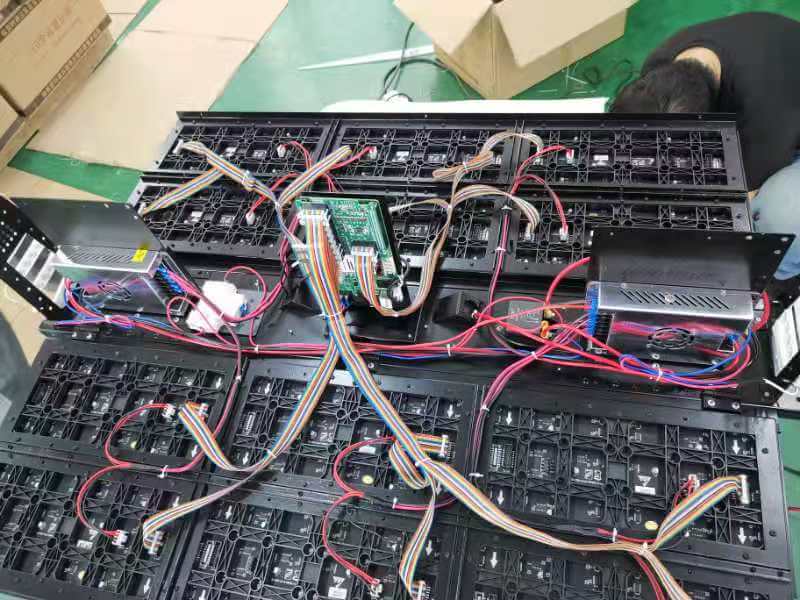
Rear-service design matters more than buyers expect. When a module fails, a front-service unit comes off the roof; a rear-service unit opens on the car in fifteen minutes. Across a 50-taxi fleet, that difference is a part-time technician’s salary.
Autopsy of a $400 Screen: Three Deaths We Keep Seeing
Can a $400 screen survive a real deployment? Some do, for a season. When they stop, it is almost always one of these three—generic failure modes, no brand names, and each has arrived at our bench from multiple factories.
Death one: the power supply cooks. You smell it before you open the lid — hot varnish with a sweetness to it, the signature of vented electrolyte. Inside: bulged capacitor tops, a brown halo around the transformer. Put a scope on the 5 V rail and you read 300 mV of ripple where 50 belongs.
Death two: water ingress wearing the striped suit. The field complaint reads “dead lines on the right side.” Strip the module and the lamp pins show white-green corrosion mapping exactly to the bottom two inches of the cabinet—condensation wicked upward through the ribbon connectors, after the edge-bead lid seal cracked at one corner. Dead vertical columns, two to four modules wide, after the first rainy season: the classic signature.
Water always wins. Your only choice is whether it wins inside a drainage channel or inside your PCB.
Death three: lamp decay nobody can prove. The face reads visibly dull, the buyer files a warranty claim, and the factory asks for the baseline luminance report from shipment. There is no report. There never was one. The claim dies in an email thread—which is why we log measured luminance per screen at shipment. A decay claim without a baseline is an opinion, and opinions do not get warranty credits.
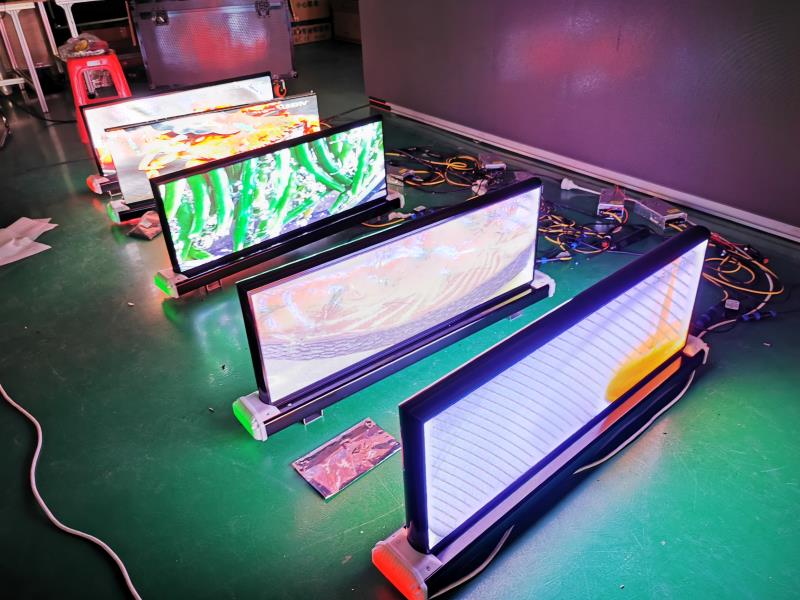
aging process
The Aging Test: What 24–72 Hours of Burn-In Catches
Every unit we ship spends 24–72 hours powered on a burn-in rack, cycling full white, gray gradients, and scrolling content. Electronics fail along a bathtub curve — a steep cliff of infant failures in the first powered hours, then a long flat plateau. The aging line exists so units fall off the cliff on our rack, not on a customer’s taxi.
What it catches, concretely: supplies that die in hour six, dead LED rows from cold solder joints, receiving cards that reset only when warm. A typical batch pulls 2–3% of units off the line. Those never ship. That number is the whole argument.
Half a day of factory time is all a supplier saves by skipping it. What it costs you is your first 40 hours on a paying customer’s taxi: installation, the complaint, the removal, freight, the replacement, the reinstall. Ask any supplier one plain question—show me a photo of your aging racks—and watch the conversation change. Our fleet buying guide lists the other checks worth running before you wire a deposit.
What You Pay Beyond the Invoice
FOB is the factory’s number, not your cost. Copy these rows into the spreadsheet you are already building:
Planning figure: landed cost runs 1.25–1.4× FOB at 20–50 units by sea. The $950 screen is about $1,200 in your yard. Budget the 25% duty-and-clearance case and treat anything lower as upside.
The 7-Question Script That Tests Any Quote
Here is the trust move. Copy these seven questions and send them to every supplier on your shortlist—yes, including ours—and require written answers.
A factory that wants your repeat order answers all seven. A trading company that plans to vanish after the deposit answers three and changes the subject.
- Lamps: “Which lamp brand and bin are the LED beads? Exact part marking, not ‘Epistar-grade.'”
- Яркость: “What will my screens sustain after factory calibration, in nits—and is 4,500 the floor or the out-of-box peak?”
- Service design: “Is the cabinet front-service or rear-service, and what are the exact weight and housing material?”
- Waterproofing: “Is IP65 certified on the finished cabinet or claimed at module level? Attach the test report.”
- Control system and CMS: “Which sender, receiver, and 4G module ship with my order—brand and model? Does the CMS require an annual subscription, and what happens to my screens if I stop paying it?”
- Warranty mechanics: “What exactly does the 3-year warranty cover, and who pays international freight on replacement parts in months 13–36?”
- Landed cost: “For my quantity to my port, quote total landed cost including export packing—and list line by line what this quote does not include.”
Question 5 deserves its own warning. Some CMS platforms hold your schedule, your media library, and effectively your screens hostage to a subscription that renews forever. Ours ships with the hardware and carries no annual platform fee—your recurring cost is the SIM data plan. Do not take my word for it. Take the written answer from every supplier before a deposit moves.
And when something breaks in month 10—roofs are hostile, something eventually will—a 3-year warranty with 5% spare parts in the box means your real exposure is freight and downtime, not the part. Rear-service cabinets shrink that exposure further: the swap happens in minutes, housing still mounted.
The Other Half of the Math: What the Media Business Pays
Hardware is half the purchase. The other half is the advertising business you are entering, and that market has public price signals. US mobile billboard day rates run $500–1,500 for static trucks and $1,250–3,600 for LED digital trucks, per AdQuick, The Rolling Ads, and Blueline rate cards. A taxi top screen is smaller than a truck face and will not command truck rates—but those numbers prove the market already pays for moving LED media.
Against your own cost structure, the CPM case is lopsided:
Two caveats keep that table honest: the taxi figure is your cost, not a rate anyone buys at; and every outdoor impression count—ours included—is a modeled estimate until a third party audits it. (The CMS vendor claim of 50,000 daily impressions per vehicle? Treat it as a ceiling. We model 25,000.)
A worked example, one car, one week—every assumption arguable:
25,000 impressions/day × 7 = 175,000 weekly. The loop carries ~10 advertiser slots, which slices to roughly 100 sellable slot-weeks per car. At a realistic-to-optimistic 1.2% sell-through and $80 per slot-week: 1.2 slots × $80 = $96/week ≈ 415/monthgross.Minus driver share, CMS, SIM, and misc. (415/month gross). net is ~$349 per car per month. On ~$1,200 landed hardware: payback in about 3.4 months.
Now the same math across configurations, with advertiser demand priced in:
Note what the table argues: the cheapest configuration does not pay back fastest once demand is priced in — single faces are harder to sell against double-sided competitors on the same rank. And if sell-through sits at zero for your first four months while you sign advertisers (common), payback is infinite no matter what a table says. Carry six months of operating cash, minimum.
One spec earns its own paragraph because it decides how you look on camera: 3840 Hz refresh. Below ~2,500 Hz, phone cameras catch the beat between panel refresh and shutter as rolling dark bands straight across your advertiser’s content. Livestreamers, news B-roll, a tourist clip that travels—digital-out-of-home buyers increasingly ask for footage as proof of play, and banded footage is a refund conversation. Refresh lives in the driver ICs and cannot be retrofitted in the field. It is bought, or not bought, at the BOM stage.
Who Should Not Buy a Taxi Top Screen Yet
Honesty costs us money here. I am going to spend it anyway.
Do not buy yet if your city is too small to sell impressions—a screen nobody sees has no inventory value. Do not buy yet if nobody on your team sells ads; hardware does not sell inventory, and unsold slots are pure depreciation. Do not buy yet if your city’s rules on roof-mounted digital signage are unresolved — pilot one unit after written clarification, not a fleet before it.
And if you run one cab and expect passive income from a roof screen, wait. One screen, one seller, one cab is a hobby with brackets.
The buyers who do well share two traits: they can sell the ad space or already own the eyeballs, and they pilot before they scale.
Taxi Top LED Display Cost: FAQ
Does the price include shipping? No. Every figure here is FOB Shenzhen—finished, tested, packed at our dock. Freight is quoted once quantity and destination port are known. Be suspicious of any supplier who quotes “everything included” without asking where you are.
How much is the all-in landed cost? Multiply FOB by 1.25–1.4 at 20–50 units by sea. A $950 double-sided P5 lands around $1,200–1,300 in the US or EU including duty, clearance, and freight—assuming current rates hold, which your broker should confirm.
Is the CMS subscription free? With our screens, yes—scheduling, media push over 4G and WiFi, and GPS fleet grouping ship with the hardware, no annual platform fee; your recurring cost is the SIM data plan. Plenty of suppliers structure it differently, which is precisely why question 5 exists.
What is the minimum reliable spec? Double-sided P5, named-brand lamps, 5,000+ nits sustained at the face, IP65 verified on the finished cabinet, 3840 Hz refresh, 72-hour aging test. Below that, you are buying a replacement cycle—lamp life is rated at 100,000 hours, but lamps are not what kills screens. Power supplies and water are.
P2.5 or P5 for a taxi roof? P5 for anything read at street distance. P2.5 only when advertisers in pedestrian districts and slow ranks pay a premium for fine detail—and most markets do not.
Can I order one test unit before a fleet? You should—and you can start from a single unit, no minimum fleet order. One screen on one taxi for 60 days proves install fit, brightness against your sunlight, the CMS workflow on your phone, and what your drivers say about it—before multiplier risk enters the picture.
What are the payment terms? Sample and small orders go by credit card, PayPal, or full advance T/T; fleet orders run standard 30% deposit with the balance before shipment. We confirm the exact terms on the proforma invoice—and if a supplier refuses to put payment terms in writing, treat that as an answer.
Open One Before You Buy One
A quote tells you a number. A teardown tells you the truth.
Send us the quote you are holding—from any supplier, including the cheapest one—and we will mark it up line by line against the BOM table above: what is real, what is missing, what it costs landed at your port. Or skip the paperwork and put a sample unit on your own taxi first.
Contact us for a configuration-matched quote and a test unit.