
How Much Does a Jumbotron Cost in 2026? Complete B2B Price Breakdown for Procurement Managers
How Much Does a Jumbotron Cost in 2026? The B2B Price Breakdown Most Suppliers Won’t Send You
A school board in Texas called us last quarter. They had three quotes for a “jumbotron”—$180,000, $420,000, and $890,000—for the same 40×24 ft scoreboard in the same end zone. Same pixel pitch, same supposed specs. All three suppliers claimed to be “manufacturers.”
The cheapest quote turned out to be a trading company. The middle quote was a real factory but had cut corners on the steel structure to hit the price. The expensive quote included something nobody else did: stamped engineering drawings for the county permit office and a 5-year on-site warranty.
The school board wasn’t being upsold. They were finally seeing the real cost.
That’s the problem with jumbotron pricing. The headline number rarely matches what you actually pay. By the time you add structure, control systems, installation, permits, and shipping, the “jumbotron cost” most suppliers quote is closer to 50–65% of the total project budget. The rest gets revealed in change orders.
This guide breaks down the real numbers for 2026—what a jumbotron actually costs, what changes the price by 3–5x, and how to compare quotes that look nothing alike on the surface. The data comes from current project quotes, public stadium installation budgets, and what tier-1 Chinese factories are actually charging tier-1 buyers this quarter.
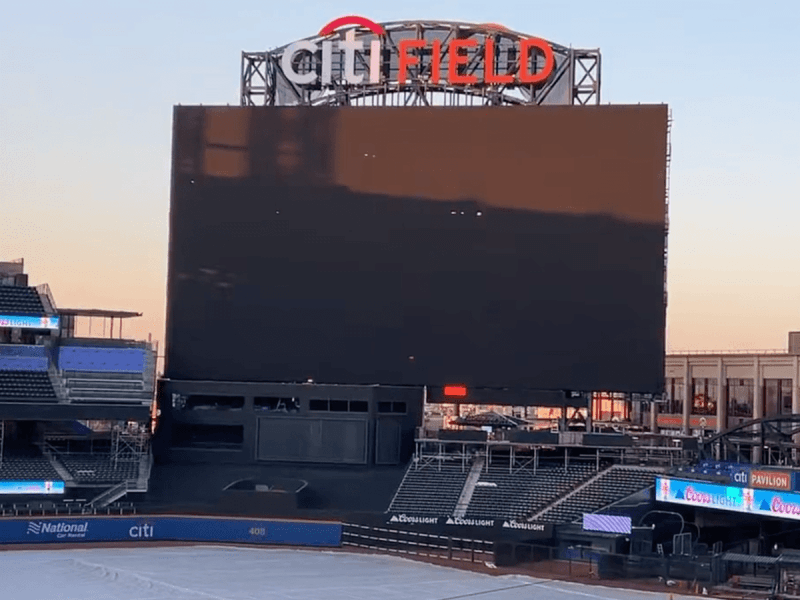
Jumbotron Cost at a Glance: 2026 Price Ranges
Skip the details if you want the headlines first. Here is what B2B buyers are actually paying in 2026:
| Project Type | Screen Size | Typical Cost Range (USD) | Common Use Case |
|---|---|---|---|
| Mini / Church / Bar | 5–20 m² (54–215 sq ft) | 15,000–95,000 | House of worship, retail, small venue |
| High school stadium | 30–60 m² (320–650 sq ft) | 90,000–500,000 | Friday night football, scoreboard replacement |
| College arena | 50–150 m² (540–1,600 sq ft) | 400,0003,000,000 | Division I/II, multi-sport facility |
| Pro / municipal stadium | 200+ m² (2,150+ sq ft) | 1,000,00040,000,000 | NFL, NBA, top-tier soccer, iconic venue |
| Rental/concert tour | 20–80 m² (215–860 sq ft) | 1,50030,000 per day | Festivals, one-off events |
For buyers importing from China (which covers 70–75% of the world’s LED display supply), the screen panel cost is typically 40–55% of the project total. The other 45–60% covers structure, control, installation, shipping, and content. Most procurement disputes happen because buyers compare panel quotes against full project quotes.
If your budget is firm, work backward from the total. Don’t anchor on the panel price.
LED Display Price Per Square Meter (2026, FOB China Reference)
When a factory quotes you a price, the first question is: what pixel pitch? Pixel pitch (P) is the distance in millimeters between LED centers. Smaller pitch = more LEDs per square meter = higher cost. The difference between P10 and P2.5 in the same cabinet can be 4–5x.
Here is the current market for FOB China pricing on standard outdoor and indoor LED panels (Q2 2026):
Outdoor LED Display Pricing (≥5,000 nits, IP65 front)
| Шаг пикселя | Best Viewing Distance | USD per m² (FOB) | Typical Application |
|---|---|---|---|
| P10 | ≥40 m / 130 ft | 350700 | Highway billboards, large stadium ribbons |
| P8 | ≥30 m / 100 ft | 500950 | Mid-size stadium, plaza screens |
| P6.67 | ≥20 m / 65 ft | 7001,300 | Standard stadium jumbotron, arena end-zone |
| P5 | ≥15 m / 50 ft | 9001,500 | High-end stadium, premium outdoor |
| P4 | ≥10 m / 33 ft | 1,2001,800 | Stadium fascia, premium outdoor advertising |
| P3.91 | ≥8 m / 26 ft | 1,5002,200 | Perimeter boards, live event touring |
Indoor LED Display Pricing (800–1,500 nits, IP31–IP54)
| Шаг пикселя | Best Viewing Distance | USD per m² (FOB) | Typical Application |
|---|---|---|---|
| P2.5 | ≥2.5 m / 8 ft | 6001,200 | Conference rooms, retail, church |
| P1.8–P2.0 | ≥2 m / 6.5 ft | 9001,600 | Control rooms, broadcast studios |
| P1.5 | ≥1.5 m / 5 ft | 1,2002,500 | Corporate lobbies, museum |
| P1.2 (COB) | ≥1.2 m / 4 ft | 2,0004,000 | Premium boardrooms, XR stages |
| P0.9 (COB) | ≥1 m / 3 ft | 4,5007,000 | Broadcast, control rooms |
| P0.7 (MicroLED) | ≥0.7 m / 2 ft | 7,8009,500 | Ultra-premium command centers |
A note on “FOB” pricing: This is the factory-gate price in Shenzhen or Guangzhou. By the time the screen reaches your site, add the following to the panel cost (as a rule of thumb, not a quote):
- Sea freight (20–40 ft container): 3–8% of panel value
- US import duty + LED-specific tariff: +20–30% landed cost for US buyers in 2026
- Installation labor (varies by region): 200–500/m² for flat walls, 700–2,500/m² for complex rigging
- Steel structure (for stadium-grade): 15–25% of panel cost
- Permits, engineering stamps, electrical upgrades: 5–15% of project total
A 50 m² outdoor P8 stadium screen at 700/m2=35,000 in panels. Add structure, install, shipping, and duties, and the same project lands at 120,000–180,000 before content or control. Most “sticker price” jumbotron quotes under $100,000 for a full stadium system are hiding something—usually a trading-company middleman, a downgraded steel spec, or no permit support.
Real Cost Examples: Three B2B Projects, Itemized
Headline price ranges hide what the budget actually looks like. Here are three realistic 2026 projects, broken down the way a real quote sheet reads.
Example 1: High School Stadium Scoreboard (Texas, USA)
Specs: 12 × 6 m outdoor LED scoreboard (72 m²), P8 pixel pitch, 6,500 nits, integrated scoreboard controller, custom steel support structure.
| Line Item | Cost (USD) |
|---|---|
| LED panels (FOB China, $750/m² × 72 m²) | $54,000 |
| Sea freight (40HC container) | $4,800 |
| US import duty + Section 301 tariff (25%) | $14,700 |
| Steel structure (designed for 90 mph wind zone) | $32,000 |
| Video processor + scoreboard control system | $8,500 |
| Installation labor (3 days, 6 technicians) | $18,000 |
| Crane + lift rental | $6,500 |
| Permits + engineering stamps (county) | $4,200 |
| On-site commissioning + content templates | $3,500 |
| 3-year on-site warranty (parts + labor) | $9,800 |
| TOTAL | $156,000 |
The school board’s lowest quote had been $89,000. It excluded structure, didn’t include tariff, and the “warranty” was 12 months parts-only with the buyer paying all shipping.
Example 2: House of Worship (Southeast Asia)
Specs: 8 × 4 m indoor LED wall (32 m²), P2.5 pixel pitch, 1,000 nits, custom curved mounting, mobile worship venue.
| Line Item | Cost (USD) |
|---|---|
| LED panels (FOB China, $950/m² × 32 m²) | $30,400 |
| Sea freight (LCL) | $2,200 |
| Import duty (5% ASEAN FTA) | $1,520 |
| Curved steel mounting frame | $7,500 |
| Video processor + switching | $3,200 |
| Installation labor (2 days) | $4,800 |
| On-site calibration + training | $1,500 |
| 2-year parts warranty | $2,800 |
| TOTAL | $53,920 |
For a non-profit on a tight budget, this is the realistic range. The published “LED wall cost” articles quoting $30,000 for the same system are using factory-gate prices without framing, freight, or installation.
Example 3: Division I College Arena Center-Hung Display (Midwest USA)
Specs: 4-sided center-hung display, each face 6 × 3.5 m (21 m² per face, 84 m² total visible area), P4 pixel pitch, 2,000 nits, 4K processing, integrated scoring system, integrated below-ring ribbon.
| Line Item | Cost (USD) |
|---|---|
| LED panels (FOB China, $1,400/m² × 84 m²) | $117,600 |
| Sea freight (two 40HC containers) | $11,000 |
| US import duty + Section 301 (25%) | $32,150 |
| Custom 4-face steel rigging (rated for 12,000 lb load) | $185,000 |
| Winch + hoist system (raise/lower for maintenance) | $48,000 |
| 4K video processors + redundancy | $35,000 |
| Scoreboard integration (Daktronics or All Sport) | $22,000 |
| Installation labor (10 days, 8 technicians) | $96,000 |
| Rigging certification + structural engineering stamps | $18,000 |
| Permits + electrical upgrades | $14,000 |
| On-site training + 5-year warranty | $42,000 |
| Below-ring ribbon (optional, P6, 60 linear m) | $48,000 |
| TOTAL | $668,750 |
For a pro-grade college installation, the panel is less than 20% of the budget. The reason college arena projects balloon past their initial quotes: the structure, rigging, and rigging certification are usually underestimated by 30–50% in early-stage planning.
The Buy vs. Rent Decision: When Does Owning Make Sense?
For one-off events, festivals, and touring shows, rental often beats purchase. For permanent venues, it almost never does, but the math depends on usage frequency.
Rental Pricing (2026, with operator)
| Rental Type | Daily Rate (USD) | Typical Use |
|---|---|---|
| Small indoor screen (10–20 m², P2.5–P3) | 1,5004,000 | Corporate events, conferences |
| Mid-size temporary build (20–40 m², P3.9) | 4,00012,000 | Trade shows, regional concerts |
| Large outdoor jumbotron (40–80 m², P4–P6) | 12,000–30,000 | Festivals, stadium concerts |
| Premium/signature event | 30,000–45,000+ | Marquee festivals, brand launches |
Watch the line items. А 5,000/dayrentaloftenbecomes18,000/day with transport, rigging crew, power generation, and weather insurance. Get a “delivered and operational” quote, not a “screen on a truck” quote.
When to Buy, When to Rent
| Scenario | Recommendation | Почему |
|---|---|---|
| Permanent stadium/arena/venue | Buy | Asset, 10+ year life, sponsor revenue covers cost in 2–4 years |
| Annual event (1–3 times/year) | Rent | Buying a 300K screen for 30K/year of use is a poor ROI |
| Music tour/festival circuit | Rent (touring rate) | Logistics, transport, insurance, storage all favor rental |
| Church/school with weekly use | Buy | Asset appreciation, daily operational use, content flexibility |
| Pop-up brand activation (single event) | Rent | One-time use, no residual value |
| Multi-city roadshow (2-week tour) | Rent (multi-city rate) | Negotiate transport + crew in one contract |
Rule of thumb: If you would rent the same screen for more than 40 days per year, buying it is usually cheaper. Below 40 days, rental wins on total cost, flexibility, and zero capital risk.
The 7 Factors That Change Jumbotron Price by 3–5x
When two suppliers quote you 200,000and700,000 for what looks like the same jumbotron, one of these seven factors is different. Most of the time, more than one.
1. Pixel Pitch (Most Impactful)
P10 to P2.5 in the same cabinet = 4–5x price difference. This is the single biggest cost driver. Don’t overspec—a stadium scoreboard that will be viewed from 50+ meters does not need P3.
| Расстояние просмотра | Recommended Pitch |
|---|---|
| 1–5 m (4–16 ft) | P0.9 – P1.5 |
| 5–15 m (16–50 ft) | P1.5 – P2.5 |
| 15–30 m (50–100 ft) | P3 – P4 |
| 30–60 m (100–200 ft) | P5 – P6.67 |
| 60 m+ (200+ ft) | P8 – P10 |
If a supplier is recommending P3 for a 60-meter viewing distance, they’re either upselling or don’t know stadium use cases.
2. Brightness (Nits)
- Indoor: 800–1,500 nits is enough.
- Outdoor shaded: 3,500–5,000 nits.
- Outdoor full sun: 5,500–7,500+ nits.
Each step up in brightness is roughly +5–10% on the panel price. Outdoor jumbotrons under 5,000 nits will be unreadable in afternoon sun—and this is where many “cheap” quotes cut corners. Cheap screens can also lose 20–30% of rated brightness after warming up for an hour, so the spec sheet number and the real-world number diverge fast.
3. Cabinet Quality (Hidden in the Details)
- Die-cast aluminum (premium): lighter, better heat dissipation, precise alignment, faster rigging. Worth the +15–25% over steel for permanent installs.
- Sheet metal/steel (budget): heavier, harder to align, slower install. Acceptable for ground-supported or short-term permanent.
- Magnesium alloy (top tier): best strength-to-weight ratio, used in touring rental panels where weight matters most.
The cabinet is where tier-1 factories and tier-3 factories differ most. A cheap cabinet looks identical in a spec sheet—until you try to align 200 panels in a stadium end-zone and discover the seams are 3mm off.
4. Ingress Protection (IP Rating) — Outdoor Only
- IP65 (front) / IP54 (rear): Standard outdoor. Sufficient for most climates.
- IP66 / IP67: For coastal, high-humidity, or high-pressure-wash environments.
IP65 is enough for most jumbotron applications. The real failure mode is not direct water — it’s humidity cycling, which we covered in detail in our IP Rating Moisture Guide. For tropical or coastal venues, spec IP66 front + IP65 rear, and confirm the cabinet has conformal coating on PCBs.
5. Refresh Rate & Gray Scale
- 1920 Гц: Bare minimum for broadcast. Visible scan lines on camera.
- 3840Hz: Industry standard for live sports broadcast. Required by most leagues.
- 7680Hz: Premium, only needed for slow-motion super-replay cameras.
A 1920Hz screen saves $15–25/m² on the panel. For a stadium that hosts any broadcast events, that saving gets eaten the first time a director complains about scan lines on the jumbotron footage.
6. Control System (Often 15–25% of Project Cost)
The processor, sending cards, receiving cards, and software are easy to under-spec. For multi-screen installations (center-hung, ribbon boards, scoreboard), each screen face may need independent control + redundancy.
- Бюджет (1,5004,000): Single processor, no redundancy, fixed content loops.
- Mid-range (8,000–25,000): Novastar or Brompton processor, dual sending cards, live input switching.
- Pro (35,000–100,000+): 4K processor with redundant power, integrated scoreboard control, broadcast integration, fail-over.
The control system is also what locks you into an ecosystem. If you choose Novastar, all your content software, control rooms, and technician training are Novastar. Switching later is expensive.
7. Installation Environment (The Hidden Multiplier)
- Flat wall, ground-access install (mall, plaza, building facade): baseline cost.
- Stadium end-zone, existing scoreboard frame: +20–40% over baseline for crane + structural tie-in.
- Center-hung arena display: +80–150% over baseline for rigging, hoist, structural engineering.
- Rooftop, tower, or cantilever: +100–300% over baseline for engineering + access + safety systems.
The same 50 m² of LED panels can cost 50,000toinstallonaflatwallor250,000 to install center-hung in a 20,000-seat arena. The screen is rarely the hard part. The support is.
What’s Missing from Most “Jumbotron Cost” Quotes
When a supplier sends you a $200,000 quote, here are the line items they are most likely to have under-quoted or left out entirely. Add these to the headline number before you budget:
| Often Omitted | Typical Cost | Why It Matters |
|---|---|---|
| Stamped engineering drawings | 3,00015,000 | Most US counties require PE stamps for LED structures over a certain height. No stamp = no permit. |
| Spare modules (3–5% of total) | 3–5% of panel cost | You’ll break panels. Always. Spare modules shipped with the order are 80% cheaper than emergency re-orders. |
| Rigging certification | 5,00025,000 | Insurance and venue requirements. Many installers won’t sign off without it. |
| Electrical upgrade | 5,00050,000 | Old venues often don’t have the power capacity for a 50 m² screen. |
| Content management system (CMS) license | 2,00020,000/year | Cloud-based CMS for live content, scheduling, remote control. |
| On-site training | 2,0008,000 | Operator training is usually an extra. Don’t skip it. |
| Annual maintenance contract | 5–10% of project value | Most warranties are parts-only. Labor is on you unless you pay for the service contract. |
| Insurance during installation | 1–3% of project value | Crane + lift work on a stadium is high-risk. Required by most venues. |
| Duty + tariffs (US import) | 20–30% of panel + freight | Section 301 tariffs on Chinese LED still apply in 2026. |
| Permit fees | 50015,000 | Varies wildly by jurisdiction. Coastal California is not the same as rural Texas. |
A good rule of thumb: take the supplier’s quote, add 20–30% for items they didn’t list, and you have a realistic project budget. The quotes that look cheapest almost always omit the most items.
How to Compare Two Jumbotron Quotes That Look Nothing Alike
The Texas school board’s three quotes ranged from 180K 890K. To compare them fairly, we built a 12-point scorecard. Use this when you receive multiple bids:
| Scorecard Item | Why It Matters | Red Flag |
|---|---|---|
| Pixel pitch in mm (not “high-res”) | “HD” means nothing. P6 is not P3. | Quote says “high-definition” but won’t list the number |
| Brightness in nits (measured, not peak) | Peak brightness is the first-second reading. Spec should list sustained brightness. | Only “max brightness” listed, no sustained |
| Cabinet material (die-cast aluminum vs steel) | Affects weight, alignment, install time, lifespan | “Standard cabinet” with no material spec |
| Refresh rate (Hz) | Below 1920Hz = scan lines on camera | 960Hz or 1920Hz, no mention of gray scale |
| Ingress protection (IP rating front/rear) | Outdoor must be IP65+ front; IP54+ rear | “Waterproof” with no IP code |
| Warranty (parts + labor, length, on-site vs return-to-factory) | “2-year warranty” usually means parts only, shipped back to China | “Warranty available” without details |
| Stamped engineering drawings included | Required for US commercial permits | “Engineering available at extra cost” — means they don’t have it |
| Spare modules included (3–5%) | You’ll need them. Always. | “Spare modules available” (means: at extra cost) |
| Installation labor scope defined | “Installation included” is not the same as “installation + commissioning + training” | Vague installation scope |
| Local references (similar venue type) | A factory that has done 50 stadium scoreboards is a different risk than one that has done 50 mall displays | No references, or only references to different product types |
| Manufacturer vs trading company | Trading companies add 15–30% margin and provide no engineering support. Factory-direct is the only way to get engineering depth. | Supplier won’t share factory photos, certifications, or production capacity |
| Tariff/duty responsibility defined | Who pays Section 301 in 2026? FOB buyer does, but DDP supplier is responsible for clearing customs | Vague Incoterms or no Incoterms specified |
If two quotes differ by more than 30%, the scorecard will almost always reveal that the cheaper one has 3–5 red flags the expensive one doesn’t. The expensive quote isn’t padding — it’s quoting the real project.
Where Eyecatchmedia Fits in This Picture
We are a Chinese LED display manufacturer with 14 years of production experience, exporting to 65+ countries. For the project types covered in this guide, we typically work in the following ranges:
- High school/community stadium (30–60 m² P6.67–P8 outdoor): 90,000–280,000 project total
- College / arena center-hung (50–150 m² P3.9–P5): 400,000–2,500,000 project total
- House of worship / corporate (10–50 m² P1.5–P2.5 indoor): 25,000–180,000 project total
- Pro stadium / municipal (200+ m²): quoted per project, typically 1.5M–15M
What we provide that most Jumbotron cost guides don’t:
- Real FOB pricing per m² by pixel pitch — no “contact for quote” filler
- Stamped engineering drawings through our US structural engineering partner
- Factory-direct pricing — no trading company margin
- Pre-shipment inspection — third-party QC at our Shenzhen facility before container loading
- 3-year parts + on-site labor warranty (extendable to 5 years)
- Spare modules (5%) included with every stadium-grade order
For a detailed breakdown of how to run an RFQ that gets you real pricing from Chinese factories — including a copy-paste template and the 7-step import process — see our 7-step LED import guide.
For rental projects, our rental LED display buying guide covers the daily rate structure, freight logistics, and tour-grade cabinet specs.
FAQ: Jumbotron Cost Questions B2B Buyers Actually Ask
What is the average cost of a jumbotron for a high school stadium?
For a 30–60 m² P6.67–P8 outdoor scoreboard with full installation, structure, and warranty, expect 90,000–500,000 total in 2026. The median project for a Texas-sized high school budget lands around 150,000–220,000. Quotes under $90,000 for a full system almost always exclude structure, tariff, or proper warranty.
How much does it cost to rent a jumbotron for one day?
Daily rental in 2026 runs 1,500–30,000+ depending on size:
- Small indoor (10–20 m²): 1,500–4,000/day
- Mid-size temporary build (20–40 m²): 4,00012,000/day
- Large outdoor (40–80 m²): 12,000–30,000/day
- Premium festival (signature acts): 30,000–45,000+/day
Always ask for a “delivered, rigged, and operational” quote—transport, crew, and power are typically 30–50% on top of the headline daily rate.
How much does an NBA-style center-hung jumbotron cost?
A 4-sided center-hung display with each face 6 × 3.5 m or larger (P3.9–P4) typically runs 1.5M–5M for college/Division I venues. NBA-arena-grade systems with 4K processing, integrated below-ring ribbon, hoist systems, and broadcast-grade refresh rate run 5M–40M+, depending on size, rigging, and integration. The panels are usually less than 25% of that cost.
Is buying from China cheaper than buying from a US integrator?
For the panel hardware itself, yes — typically 30–45% cheaper at the factory gate. For the total project, the gap narrows significantly because:
- US integrators absorb the tariff, freight, customs, and structural certification
- They also handle installation, warranty service, and content integration
- Trading-company middlemen in China often wipe out the price advantage
If you are equipped to handle installation, content, and service yourself (or work with a local AV integrator), buying factory-direct from China saves 20–35% on total project cost. If you need turnkey service, the gap shrinks to 10–20% once you account for the local integrator’s project management overhead.
How long does a jumbotron last before it needs replacement?
Quality outdoor LED panels last 80,000 – 100,000 operating hours (15–20 years at typical stadium use of 8–12 hours/week). The failure modes that shorten lifespan are:
- Humidity corrosion (covered in our IP Rating guide)
- Power supply failures (cheap capacitors fail first)
- Driver IC degradation (after 7–10 years, expect some color shift)
- Mechanical damage (panel strikes from balls, equipment, vandalism)
Spare modules (5% of order) typically cover the first 5 years of failures. Plan a mid-life refurbishment budget (years 7–10) for power supply and control card refresh.
What’s the difference between a “jumbotron” and a regular LED display?
“Jumbotron” was a Sony trademark from the 1980s for the first large-format stadium video board. It became generic—like Kleenex or Xerox—and now means any large-format LED video display, typically 50 m²+ and used in stadiums, arenas, or public spaces. There is no technical difference; it is a size/use-case category, not a separate product type.
Can I import a jumbotron from China without a US-based installer?
Technically yes, practically no—for any stadium-grade install. You will still need:
- A US-licensed structural engineer to stamp drawings for permits
- A US-licensed electrical contractor for the high-voltage tie-in
- A local rigging crew with crane certification
- A US-based service partner for warranty work
The factory-direct savings are real, but they require you to coordinate the project. Most first-time buyers underestimate this and end up hiring a US integrator anyway — at which point the factory-direct advantage has largely been spent on project management overhead. The exception is large venues, sports leagues, and repeat buyers who have in-house AV teams.
Get a Real Jumbotron Quote in 72 Hours
If you have a project spec (venue type, screen size, viewing distance, indoor/outdoor), we can return a factory-direct quote with line items, engineering scope, and a payment schedule within 3 business days.
What we need from you:
- Venue type and seat count
- Approximate screen size (m wide × m tall) and intended location
- Primary viewing distance (closest seats to the screen)
- Indoor or outdoor
- Existing structure (scoreboard frame, wall, ground support) or new build
- Content needs (live broadcast, scoring integration, advertising, fixed content)
- Desired delivery timeline
Send it to [email protected] or use the RFQ template in our LED import guide for a copy-paste format. We’ll come back with a real number — not a “starting from” placeholder.