
How to Audit a Chinese LED Display Factory Before Wiring Money
A led display factory audit is four checks in sequence: desk verification of the business license and certificates, a live video walk of the production floor, a sample tested against the quoted BOM, and one day on site before any container order. Each gate costs less than the loss it prevents. Run all four before the wire.
The deposit invoice says 30% of $47,000. Fourteen thousand one hundred dollars, wireable this afternoon. Your finger is over the send button, and the knot in your stomach is not cowardice. It is data.
Every importer who has been burned tells a version of the same story. Clean quote, fast replies on WhatsApp, money moved — and the goods that landed were not the goods quoted. The failure was visible two weeks earlier, for free.
So read this first. The sequence takes roughly two weeks end to end, and every gate costs less than the mistake it catches. A trading company slips out at Gate 1, for $0. A capacity lie slips out at Gate 2, for $0. A post-deposit spec switch dies at Gate 3, for the price of one sample. By the wire, almost nothing is left to luck.
One honesty note on the genre: generic China-sourcing audit checklists exist — business license, third-party inspection services. What doesn’t exist is the LED layer, because a generic auditor can’t tell an SMT line from a warehouse. This guide is that layer.
The Four Gates at a Glance
| Gate | What you do | Time | Custo | What it catches |
| 1. Desk verification | License, certificate forensics, export data | One evening | $0 | Trading companies, rented certificates |
| 2. Live video audit | Unscripted tour of the production floor | 45 minutes | $0 | Capacity lies, outsourced assembly |
| 3. Sample | One unit paid by card, tested by you | 2–3 weeks | Sample price + freight | Spec lies, BOM switches |
| 4. In-person audit | One day on the floor | One day + travel | Airfare and a hotel | Anything the first three missed |
Each gate is cheap because the failure it catches is expensive. A container of wrong modules costs the deposit, the freight, the install window, the show. Fourteen thousand dollars buys a lot of evenings and a lot of samples.
Gate 1: Desk Verification — One Evening, $0
Verifying a Chinese LED display manufacturer starts with public records most buyers skip. Pull the business license at China’s national enterprise credit registry (gsxt.gov.cn) against the company’s Unified Social Credit Code. Search the name exactly as it appears on the invoice, then read three things — and while you’re at it, match a third name: the bank account you’re told to pay. Three names, three matches, or you stop there.
Scope of business must include manufacturing — LED displays, LED electronic products, anything of that shape. If the scope reads like a trading catalogue — import-export agency, wholesale, retail — you are talking to a middleman with good English. (Not automatically a scam; some aggregate decent factories. But you deserve to know which one you’re paying, and it changes the margin math.) Registered capital and registration date come next; a company incorporated last year on thin capital is not a five-year partner. Near-identical Shenzhen entities are the favorite costume of certificate renters.
Certificate forensics — I weight this check heavier than any site visit. Open the CE, FCC and RoHS PDFs and read the company name on each certificate against the invoice issuer and the business license. A three-way mismatch means one of two things: you are buying from a trader, or the factory is renting someone else’s certificate — either way, the paper does not cover what you are buying. Verify the report number with the issuing body while you’re there: SGS, TÜV and Intertek run lookup tools, and a genuine report survives a database search while a fabricated one survives only a PDF. This single check catches more fake factories than any workshop tour, and it takes ten minutes.
(Our CE, FCC, RoHS and UL certificates sit on the download page — run the same forensics on them.)
Customs export data comes third: paid databases show shipment records by port and description, month by month. A factory claiming steady container volume against a thin export history is telling you something, and it is not a sales pitch.
If the evening leaves questions you cannot settle, buy the professional opinion: a third-party desk report from SGS or QIMA, commonly cited at $300–500 — registry records, certificate validity, factory presence in one document. The cheapest expertise you will ever hire.
Gate 2: The Live Video Audit — 45 Minutes, $0
Not a produced video. Not a WeChat clip from last year’s expo. A live call, booked on a working day, where you direct the camera.
Insist on five shots:
- SMT lines running. Surface-mount machines placing LEDs — stencil printer feeding a pick-and-place line feeding a reflow oven, all in sequence, not machines arranged like furniture. This is the hard line between a factory and a screwdriver shop: a factory that owns SMT controls lamp quality and binning; one that buys finished modules controls nothing and will never bin-match a large wall.
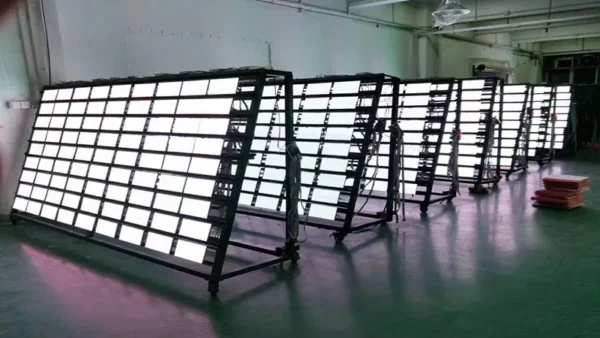
- Aging racks powered on. Rows of modules burning in, cycling white, gradients, scrolling text. Ask how long a standard burn-in runs; 48–72 hours is the honest range, and the answer should be instant.
- The calibration station, meter visible. A colorimeter on a fixture, per-module gain leveling on a PC, a before-and-after uniformity map on the monitor. No meter, no calibration — and uncalibrated walls drift into patchwork by month six.
- Real orders on the line. A cabinet carrying somebody else’s logo proves other customers ship from this floor.
- The warehouse, labeled by project. Finished goods with job tags, not a bare room and three empty flight cases.
And if the reel labels are in view, read them: the lamp brand on the feeder reel is where “Nationstar-grade” becomes a part number or becomes an excuse. If the quotation says one name and the reels carry a name you cannot find anywhere, you have your answer, printed in white on blue.
A glossy lobby, a demo wall, a row of sales desks — that is a showroom tour, not an audit. The refusal itself is the answer: offer a slot inside their working hours, keep it to 20 minutes, name the route — SMT, aging racks, warehouse, done. If they still refuse, or counter with a produced video, you have your answer for one email. Buyers who verify an LED screen factory by showroom get showrooms. Ask for the floor.
Gate 3: The Sample as Truth Serum — 2–3 Weeks
One unit, ordered like a real customer, paid by credit card.
The card matters more than it sounds. A confident factory allows it — a manufacturer who plans to stand behind the spec has nothing to fear from a reversible payment, and ours does. A supplier who insists on bank transfer only, for a single sample, is previewing how the deposit conversation will go later.
When the sample lands, test it like an engineer, not a tourist:
- Sustained nits at full white after an hour — not the datasheet peak (calibration typically costs 10–20% of out-of-box brightness; the peak-vs-sustained trap is explained in our brightness guide)
- Uniformity checked again after 72 hours of cycling
- Open the cabinet. The PSU brand is printed right on the unit, and the gap between a named supply and a no-name one accounts for most of any factory’s burn-in failure rate. A confident factory invites the screwdriver; a nervous one quotes the warranty clause instead
- Lamp marking on the modules versus the quotation — same reel-label logic, one step downstream
Then do the step almost nobody does: lay the quoted BOM beside the sample, line by line — LED brand and bin, driving IC, power supply brand, cabinet material, connectors. The itemized cost table in our taxi-top LED cost teardown shows the format — hold your supplier’s quote to the same standard. The classic fraud — a sample built with quoted LEDs, a shipment built with something cheaper — is visible only to buyers who checked the BOM against something physical.
The sample also tests the relationship: response times, honesty about what the unit cannot do, willingness to send a burn-in log. Two weeks in, you know what this company is like after the money arrives.
Gate 4: The In-Person Day — For Container Scale
Container-scale orders justify a flight. Not for the showroom. For one day on the production floor with the right people. Three moves make the day.
Sit with the production manager, not the salesman. Salespeople rehearse; production managers live in the building. Ask one question: “What fails burn-in most often?” A real factory answers instantly — power supplies, then cables and connectors, whatever the local failure pattern is. The production manager knows it because they fix it weekly. “Nothing fails” is not confidence; it is a refusal to keep records. A salesman who must check with the engineer on a question this basic has never stood on the floor he is selling you.
Watch a module swap. Ask someone to pull a module and refit it while you time it — connector quality, magnet or screw mounting, front or rear service. A rental cabinet designed for front service should swap in under a minute with one Allen key, and a crew that does this daily will not need to confer first. Two minutes of watching tells you what your install crew will feel for years.
Read the floor’s tempo. Staged looks like this: a floor clean enough to eat off, zero work in progress, workers who never look up, a tour route that never forks. Real looks like this: half-finished orders on the line, cable offcuts near the assembly benches, someone drinking tea who glances up and goes back to work. The tea drinker is a good sign. So is the WIP. A factory with no half-made goods on a working day is a showroom with air conditioning. And do the capacity math at the aging hall: count the racks and slots, multiply by shift hours, compare against the monthly output the salesperson just quoted. If the math cannot cover their claimed volume, that volume is not theirs. Find the batch log sheet too — a healthy line pulls 2–3% of modules during burn-in and writes each failure down. Zero defects on the log does not mean perfection. It means nobody is writing anything down.
Take the reference call before you fly. Our UK partner runs a 630-cabinet P3.91 rental fleet and takes reference calls from serious buyers — uptime, spares policy, how we handled the shipment that went wrong. A supplier who offers references unprompted is telling you something; one who stalls is telling you more.
If travel is genuinely impossible, the $300–500 desk report scales up to an inspector day on site — hand the inspector your specifics: the cert numbers you pulled, the lamp brand the quotation claimed, the license names you matched. A third party verifying your specifics is worth $400. A third party wandering a floor with a generic template is a $400 postcard.
We have hosted buyer audits for more than ten years — video calls and in-person visits are routine here, not favors (a short history is on the about page). Buyers who fly in say the same thing afterward: the floor matched the video. The gates exist so the site visit is a confirmation, not a discovery.
Red Flags, and What Each One Is Telling You
| Red flag | Gate | What it usually means |
| Certificate name differs from invoice name | 1 | Trader, or rented certificate |
| Business scope lists trading, not manufacturing | 1 | Middleman with a sales team |
| Export records do not match claimed volume | 1 | Inflated capacity story |
| Tour shows lobby and showroom, never the floor | 2 | Assembly is outsourced |
| Refuses an unscripted live video call | 2 | There is no line to show |
| Full showroom + empty aging hall on the same working day | 2/4 | Everything is display, nothing is production |
| Refuses card payment on a single sample | 3 | Cash-flow trouble, or a dispute habit |
| Sample spec does not match the quoted BOM | 3 | The post-deposit switch has started |
| No one on the floor can answer the burn-in question | 4 | You are talking to sales, not production |
One red flag is a conversation. Two is a warning. Three ends the negotiation — and you have kept $14,100 for $0.
Then, and Only Then, the Wire
The gates do not just decide whether to send money. They sequence it.
Sample by credit card — small, reversible, documented. Then a pilot on 30/70 T/T: thirty percent against a signed PI with the BOM attached, the balance against inspection or the bill of lading. Ten to twenty cabinets prove the process at stakes you can absorb. The container comes after the pilot lands and matches spec. Never 100% in advance — a factory that insists on it is describing its cash flow, not its quality, and a factory that passed all four gates rarely asks. Letter of credit where both sides can afford it: real money and paperwork on both ends, better suited to large orders between established parties than a first $47,000 experiment.
Keep the contract boring. BOM attached, burn-in hours stated at 48–72 with a log to prove it, acceptance criteria written, spares and warranty printed. The audit gets you a real factory. The paperwork gets you the factory you audited.
The One-Page Factory Audit Checklist
Print it, fill it, staple it to the payment approval. A blank row means the wire is not ready.
| Gate | Pass / Fail | Evidence on file |
| 1. Desk verification | License screenshot with Unified Social Credit Code; scope shows manufacturing; CE/FCC/RoHS names match invoice; export data pulled | |
| 2. Live video audit | Recording with timestamps: SMT line, aging racks, calibration meter, real-order branding, labeled warehouse | |
| 3. Sample | Meter readings vs quote; full burn-in completed; BOM matched line by line; PSU brand photographed; card receipt | |
| 4. In-person audit | Production manager Q&A noted; module swap video; aging-hall capacity math; reference call notes | |
| Payment terms | Signed contract and PI with BOM; deposit %; balance trigger defined |
Five rows, one page. It belongs in the approval email, where the colleague who countersigns the wire sees evidence instead of enthusiasm.
FAQ
**Is a third-party audit worth $400?** $400 is the price of one pallet. Against a $14,100 deposit it is under 3%; against a failed container, a rounding error. Buy it when the order is container scale, when you cannot travel, or when Gate 1 leaves you unsure — and hand the inspector your specifics, not a generic template. Skip it for a two-cabinet order you can judge with your own meter.
What if the factory fails one gate but passes the others? The working rule: paperwork problems are fatal, tempo problems are negotiable, product problems are fatal. A certificate name that doesn’t match is fraud — walk away. An unoccupied aging hall might be a slow week — ask for a dated video of the racks across three working days. A failed sample gate is also fatal, because the sample is the factory’s best work. One fail is a question; two fails is a pattern, and patterns do not fix themselves between deposit and shipment.
How long does a proper led display factory audit take? About two weeks end to end. Gate 1 is an evening. Gate 2 is a 45-minute call bookable within days. Gate 3 is the long pole at two to three weeks including freight. Gate 4 is one day on site once the first three pass. Compress the timeline and the first casualty is usually the sample — the stage where spec lies die.
The factory refuses a live video tour. Now what? Offer a slot inside their working hours, keep it to 20 minutes, name the route. If they still refuse, or counter with a produced video, you have your answer for one email. A manufacturer with a running floor wants to show it — the floor is the one thing they cannot fake.
What deposit is normal after the gates pass? Thirty percent, balance against inspection or shipping documents, is the market norm once a factory has passed the four gates. A verified factory demanding 100% advance is describing its cash flow, not its value. Renegotiate; if it cannot move, treat that as a fifth red flag.
Run the Gates on Us First
That is the method. Four gates, about two weeks, each one cheaper than the failure it prevents.
Run them on us before you spend anything. Book the video audit this week and steer the camera yourself. Take the reference call with our UK partner and their 630-cabinet rental fleet. Pull the CE, FCC, RoHS and UL certificates off the download page and match every name against the invoice we send.