
Transparent LED vs Holographic LED Fan: Which Is Right for Your Retail Window?
Reading time: ~13 min | Best for: Retail brand managers, visual merchandising directors, storefront designers, and AV integrators choosing between transparent LED and holographic fan displays for a retail window installation.
The 30-Second Version
If you are choosing between a transparent LED display and a holographic LED fan for a retail window, the decision comes down to one question: do you need a display that runs 12 hours a day, 365 days a year—or a display that creates a 2-week buzz?
| Your situation | Recommended format | Typical cost |
| Permanent storefront, daily content rotation, product visible through glass | Transparent LED film or cabinet | USD 400–2,500 / m² |
| Flagship store, luxury brand, maximum transparency needed | Transparent LED glass screen | USD 800–2,500 / m² |
| Trade show booth, pop-up activation, 2–4 week campaign | Holographic LED fan | USD 120–800 / unit |
| Jewelry counter, single-product reveal, controlled lighting | Reflective holographic showcase | USD 1,500–8,000 / unit |
If your project falls in the transparent LED rows, the rest of this guide explains which sub-format and pixel pitch to specify for your window. If you are leaning toward holographic, read the brightness and lifespan sections first — the failure modes are real, and most suppliers will not mention them until after the purchase order.
We manufacture transparent LED displays at Eyecatchmedia, so we have an obvious bias. But we also see what happens when retail buyers choose the wrong format for the wrong reason—and the data below is drawn from 200+ storefront installations across 18 countries.
Why Retailers Confuse These Two Technologies (and Why It Matters)
Walk into a display trade show in 2026 and you will see two booths drawing crowds: one showing a transparent LED film playing a crystal-clear brand video on glass, the other showing a holographic fan floating a rotating sneaker in mid-air. Both look magical. Both are called “holographic” by at least half the salespeople in the room.
They are completely different technologies.
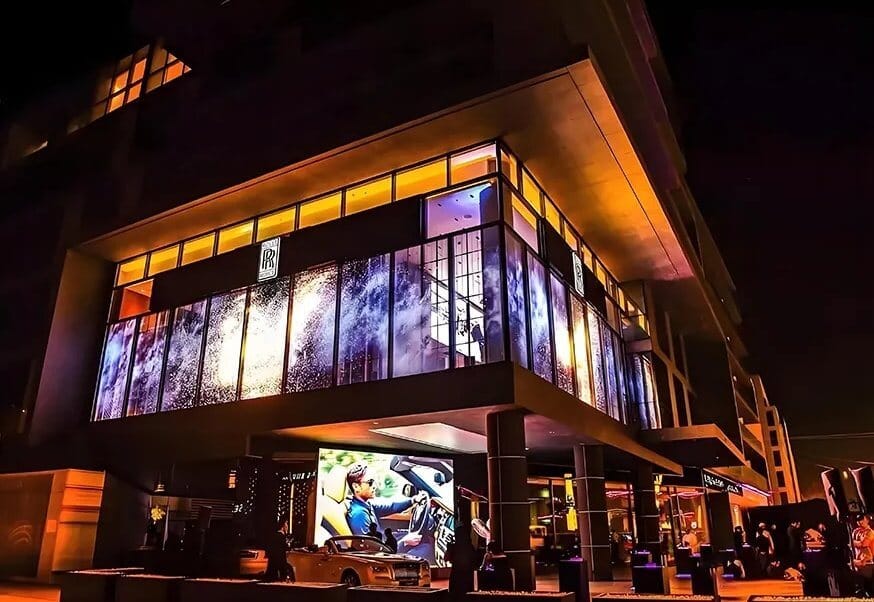
Transparent LED is a display surface—a grid of LED chips on a transparent substrate (film, glass, or mesh) that shows full-resolution video while letting light pass through. It turns your existing window into a screen.
Holographic LED fan is a persistence-of-vision device—a single spinning LED blade that creates the illusion of a floating image. It produces a low-resolution “hologram” in a small circular area.
The confusion costs money. A retailer who buys a holographic fan array expecting it to replace a storefront video wall will spend USD 15,000–40,000 on hardware that looks impressive for two weeks and becomes a maintenance burden by month six. A retailer who buys a transparent LED film expecting a “floating 3D hologram” will be disappointed by what is, essentially, a see-through video screen.
This guide gives you the physics, the pricing, the content workflow, and the 5-year total cost of ownership for each—so you choose based on your business goal, not a trade show demo.
How Transparent LED Displays Work: Your Window Becomes the Screen
The physics
A transparent LED display is built from LED chips mounted on a transparent substrate—either adhesive film applied directly to glass, laminated glass with embedded LEDs, or a rigid cabinet with transparent PCBs. The LEDs are spaced apart at regular intervals (the pixel pitch), and the gaps between them are what create transparency.
When the display is off, you see through it — transparency rates range from 65% to 93% depending on the sub-format. When the display is on, the LEDs produce a full-resolution video image. The brain fills in the gaps between pixels at normal viewing distances, so the image appears continuous.
Four sub-formats for retail
| Sub-format | Transparency | Pixel pitch | Price / m² | Best for |
| LED film (adhesive) | 65–80% | P5–P10 | USD 400–900 | Storefront windows, pop-ups, leasehold buildings |
| LED glass screen | 70–85% | P3.9–P10 | USD 800–2,500 | Flagship stores, luxury showrooms, permanent installs |
| Transparent LED cabinet | 50–75% | P2.8–P7.8 | USD 600–1,800 | Mall interiors, showroom floors, fine-pitch applications |
| Transparent LED mesh | 80–93% | P15.6–P31.2 | USD 200–600 | Building facades, large-scale architectural branding |
Where it works
- Street-facing storefronts where pedestrians need to see products through the glass during the day
- Shopping mall interiors where the display doubles as architectural lighting and brand messaging
- Luxury automotive showrooms where the car must remain visible behind the display
- Any retail window running 10–14 hours/day with frequent content updates (promotions, seasonal campaigns, product launches)
The key advantage
Transparent LED is the only format among the two that is designed for permanent, daily-use retail installation. It runs standard 1080p/4K video content—the same motion graphics your marketing team already produces for digital signage and social media. No specialized content production. No spinning motors. No reflective foils to scratch.
How Holographic LED Fans Work: The Persistence-of-Vision Illusion
The physics
A holographic LED fan is a single high-speed rotating blade—typically 40–95 cm in diameter—mounted with a strip of LED chips along one edge. The blade spins at 750–1,500 RPM. As it rotates, the LEDs flash on and off in precise patterns. Because the human eye retains an image for approximately 1/15th of a second (persistence of vision), the brain stitches the flashing LEDs into a continuous image that appears to float in mid-air.
The blade itself is thin and nearly invisible when spinning, so the image appears to hover. The background must be dark for the illusion to work — bright ambient light washes out the LEDs.
Three types of “holographic” display
| Type | How it works | Price range | Best for |
| LED fan (spinning blade) | POV illusion from rotating LEDs | USD 120–800 / unit | Trade shows, pop-ups, point-of-sale |
| Reflective showcase | 45° foil reflects hidden LED screen | USD 1,500–8,000 / unit | Jewelry counters, product reveals |
| Pepper’s Ghost stage | Large angled glass reflects hidden screen | USD 15,000–80,000 / install | Concerts, conference keynotes |
For retail windows, the LED fan is the most common choice. The reflective showcase works for indoor counter displays. Pepper’s Ghost requires a darkened environment and 2–4 meters of depth behind the glass — rarely available in a standard storefront.
Where it works
- Trade show booths where the goal is to stop foot traffic for 30 seconds
- Pop-up activations running 2–4 weeks
- Point-of-sale counters in controlled lighting environments
- Product launch events where a single rotating product image creates a “wow” moment
The key limitation
A holographic fan produces a low-resolution floating image visible from a narrow viewing angle. The circular image is typically 450–1024 pixels in diameter—suitable for logos, simple text, and basic product rotations, but not for full-motion video or detailed product photography. The image also dims sharply in bright ambient light. A sunlit retail window will wash out the hologram completely.
Head-to-Head: 8 Dimensions That Actually Matter
| Dimension | Transparent LED | Holographic LED Fan |
| Image resolution | Full video (P2.8–P10, 1080p/4K capable) | Low (450–1024 px circular) |
| 明るさ | 4,000–7,500 nits (daylight-readable) | 1,500–3,500 nits (indoor/dim only) |
| Viewing angle | 140–160° (wide) | 30–60° (narrow; image distorts off-center) |
| Daylight performance | Excellent (designed for sunlit windows) | Poor (washes out in ambient light) |
| Content format | Standard MP4/motion graphics | Custom black-background 3D animation |
| Content cost per clip | USD 200–1,500 (or in-house) | USD 2,000–8,000 (specialized) |
| Product visibility through display | 65–93% (primary feature) | None (opaque spinning blade) |
| Daily maintenance | Low (modular panel swap, 15 min) | High (motor replacement every 14–24 months) |
| Expected lifespan | 80,000–100,000 hrs (7–11 years) | 6,000–15,000 hrs (motor/foil limited) |
| Noise level | Silent | 35–55 dB (motor hum, audible in quiet retail) |
| Permitting | Low (interior-mounted, usually exempt) | Low (indoor device) |
The pattern: Transparent LED wins on every dimension that matters for permanent retail: resolution, brightness, viewing angle, content cost, lifespan, and product visibility. Holographic fans win on one dimension — novelty — and that advantage decays within 2–4 weeks of daily exposure.
Cost Comparison: Purchase, Installation, Content, and 5-Year Maintenance
Purchase price
| Format | サイズ | Hardware cost | Installation | Content (year 1) | Total year 1 |
| Transparent LED film (P7.8) | 6 m² boutique window | USD 3,600–5,400 | USD 800–1,500 | USD 500–1,500 | USD 4,900–8,400 |
| Transparent LED glass (P3.9) | 6 m² flagship window | USD 6,000–15,000 | USD 2,000–4,000 | USD 500–1,500 | USD 8,500–20,500 |
| Holographic fan array | 6 m² equivalent (12–15 units) | USD 1,800–6,000 | USD 300–800 | USD 3,000–8,000 | USD 5,100–14,800 |
| Reflective holographic showcase | 1 unit (40 cm) | USD 1,500–8,000 | USD 200–500 | USD 2,000–5,000 | USD 3,700–13,500 |
5-year total cost of ownership
| Cost component | Transparent LED film (6 m²) | Holographic fan array (15 units) |
| Hardware (year 1) | USD 4,200 | USD 4,500 |
| Installation (year 1) | USD 1,200 | USD 500 |
| Content (5 years) | USD 3,000 (standard motion graphics) | USD 15,000 (specialized 3D, 3 refreshes) |
| Motor/foil replacement | USD 0 | USD 2,400–4,500 (every 14–24 months) |
| Module/panel replacement | USD 400–800 (1–2 panels over 5 years) | USD 600–1,200 (LED strip failures) |
| Electricity (12 hrs/day) | USD 1,400 (avg 200W/m² × 6 m²) | USD 900 (avg 25W/unit × 15 units) |
| 5-year TCO | USD 10,200–11,600 | USD 27,400–31,600 |
The takeaway: Holographic fans have lower upfront hardware cost, but the 5-year TCO is 2.5–3x higher than transparent LED—driven by content production costs and motor replacements. For a permanent retail window, transparent LED is the cheaper option by year 2.
Content Workflow: The Hidden Dealbreaker
This is the dimension most retail buyers overlook — and it is the one that determines whether your display stays running or goes dark after three months.
Transparent LED content workflow
- Format: Standard MP4, H.264, 1080p or 4K
- Production: Your in-house marketing team or any digital signage content agency can produce it
- Cost per clip: USD 200–1,500, or free if produced in-house
- Turnaround: 1–3 days for a standard promotional clip
- Tools: After Effects, Premiere, Canva, or any video editor
- Content rotation: Daily or weekly — no production bottleneck
Holographic fan content workflow
- Format: Custom black-background 3D animation, exported as MP4 with H.264 codec, matching the fan’s native resolution (e.g., 1024×1024)
- Production: Requires a 3D animator with holographic fan experience. Standard video will not work—the content must be mapped to the circular POV format with a pure black background
- Cost per clip: USD 2,000–8,000 from a specialized studio
- Turnaround: 2–4 weeks per clip
- Tools: Blender, Maya, or Cinema 4D with custom export scripts
- Content rotation: Every 2–3 months — production cost makes frequent updates impractical
The real-world impact: A transparent LED display can show a different promotion every day of the week—Monday’s flash sale, Wednesday’s new arrival, Friday’s weekend event. A holographic fan typically runs the same 3–5 clips for months at a time because each new clip costs more than the display hardware itself.
If your retail strategy depends on frequent content updates (promotions, seasonal messaging, product launches), transparent LED is the only format that supports it without a content production bottleneck.
Installation and Space Requirements
Transparent LED film
- Mounting: Applied directly to existing window glass with optical adhesive
- Depth required: <2 mm (film sits flat on glass surface)
- Structural load: Negligible (film weighs 1.5–3 kg/m²)
- Electrical: Driver units mounted behind window frame or in ceiling cavity; standard 110/220V
- Installation time: 2–4 hours for a 6 m² window
- Glass compatibility: Works on standard tempered, laminated, and insulated glass. Low-E glass requires a primer (provided at no cost)
Holographic fan array
- Mounting: Each fan unit mounted on a floor stand, ceiling bracket, or wall mount behind the window
- Depth required: 30–60 cm behind glass for fan clearance and safety housing
- Structural load: 1.5–3 kg per unit; 15 units = 22–45 kg total
- Electrical: Each unit needs individual power; cable management for 15+ units
- Installation time: 4–8 hours for a 15-unit array (including cabling and alignment)
- Safety requirement: Protective housing mandatory in public-access areas (spinning blade at 1,500 RPM is a hazard)
Key difference: Transparent LED film adds less than 2 mm to your window. A holographic fan array needs 30–60 cm of depth behind the glass—space that most retail windows do not have, especially if the window is a display case for products.
Decision Matrix: Choose Transparent LED If… / Choose Holographic Fan If…
Choose transparent LED if:
- Your display runs 10+ hours per day, 365 days per year. Transparent LED is rated for 80,000–100,000 hours of continuous operation. Holographic fans need motor replacement every 14–24 months at the same duty cycle.
- Your window faces direct sunlight. Transparent LED delivers 4,000–7,500 nits—daylight-readable. Holographic fans top out at 3,500 nits and wash out completely in sunlit windows.
- You need to show products through the glass. Transparent LED preserves 65–93% visual transparency. Holographic fans are opaque — they block the view of anything behind them.
- You want to update content weekly or daily. Transparent LED runs standard video. Holographic fans require custom 3D animation at USD 2,000–8,000 per clip.
- You are installing in a permanent location (lease 2+ years). The 5-year TCO of transparent LED is 60–70% lower than a holographic fan array.
Choose holographic fan if:
- Your activation is 2–4 weeks maximum. Trade shows, pop-ups, product launches. The novelty factor is highest in the first 2 weeks.
- Your environment is controlled lighting. Indoor booths, dimmed retail interiors, evening events. Holographic fans need darkness to create the floating-image illusion.
- You want a single rotating product image, not full video. A floating sneaker, watch, or perfume bottle creates a stronger “wow” than a transparent video screen for short-duration product reveals.
- Your content will not change for the duration of the activation. One 3D clip, produced once, running on loop. No need for daily promotions.
- You have no window glass to mount on. Holographic fans work in open space; transparent LED requires a glass or transparent substrate.
The 5 Questions to Ask Before You Decide
- How many hours per day will the display run? Over 8 hours/day → transparent LED. Under 4 hours/day for a short activation → holographic fan.
- Will the window receive direct sunlight? Yes → transparent LED (minimum 5,000 nits). No, controlled lighting → either format works.
- How often will content change? Weekly or more → transparent LED. Once per activation → holographic fan.
- What is your content production budget over 2 years? Under USD 5,000 → transparent LED (in-house motion graphics). Over USD 15,000 → holographic fan (specialized 3D animation).
- Do pedestrians need to see products through the window? Yes → transparent LED (65–93% transparency). No → either format.
Eyecatchmedia’s Transparent LED Solutions for Retail and Showrooms
We manufacture transparent LED displays specifically for retail storefront installations. Our lineup covers all four sub-formats:
Window-Mounted LED Film (P5.2–P7.8)
- Brightness: 4,500–5,500 nits
- Transparency: 70–80%
- Best for: Storefront window overlays, leasehold installations, pop-up retail
- MOQ: 1 m²
- Lead time: 10–12 working days
- Custom sizes: Cut to your window dimensions (max single panel: 1.5 m × 3 m)
Indoor Transparent LED Cabinet (P2.9–P6.2)
- Brightness: 4,500–6,000 nits
- Transparency: 55–75%
- Best for: Shopping mall interiors, showroom floors, atrium installations
- MOQ: 1 cabinet (0.5 m²)
- Lead time: 12–15 working days
Transparent LED Glass Screen (P3.9–P7.8)
- Brightness: 4,000–5,000 nits
- Transparency: 70–85%
- Best for: Flagship stores, luxury automotive showrooms, permanent installations
- MOQ: 1 m²
- Lead time: 20–25 working days (custom laminated glass)
Outdoor Transparent Mesh (P15.6–P31.2)
- Brightness: 5,500–7,500 nits
- Transparency: 85–93%
- Best for: Building facades, large-scale architectural branding, outdoor curtain effects
- MOQ: 5 m²
- Lead time: 15–18 working days
What we provide with every order:
- Free 3D mockup of your window with the specified display format applied
- Site survey checklist (brightness, glass type, structural load, electrical routing)
- Content template pack (10 retail-ready motion graphics in 1080p/4K)
- 3-year warranty on LED modules; 5-year warranty option available
FAQ
Can a holographic LED fan produce a transparent effect? No. A holographic fan creates a floating image using persistence of vision—the spinning blade is nearly invisible, but the image itself is opaque. If you need pedestrians to see products through the display, transparent LED is the correct technology.
Can a transparent LED display produce a 3D floating effect? Not a true holographic floating image. However, creative content with depth cues (parallax, shadows, layering) on a high-brightness transparent LED film can produce a compelling pseudo-3D effect at a fraction of the cost. For most retail brands, this achieves 80% of the “wow” at 20% of the cost — and it runs on standard video.
How long does transparent LED film last? Rated lifespan is 80,000–100,000 hours. At 12 hours/day, that is 18–23 years of operation. In practice, brightness depreciation reaches 20–30% by year 7–8, which is when most retailers refresh the display. Holographic fan motors typically need replacement every 14–24 months at the same duty cycle.
How long does a holographic fan motor last? Motor bearings are rated for 6,000–10,000 hours of continuous operation. At 12 hours/day, that is 14–24 months before motor replacement. Replacement motors cost USD 80–200 per unit. A 15-unit array will need 2–4 motor replacements per year on average once the units pass 18 months.
Can I combine both technologies in one storefront? Yes—and this is increasingly common. A transparent LED film on the main window for daily brand messaging and promotions, plus a single holographic fan in a dedicated product display area for short-term product launch “wow.” The two formats serve different purposes and do not compete when used in different zones of the store.
What is the minimum order for a retail window? We accept transparent LED orders from 1 m². A typical boutique window (3 m × 2 m = 6 m²) with P7.8 film costs approximately USD 4,200–5,400 including driver units and mounting hardware.
Do you ship globally? Yes. We export to 60+ countries with CE, FCC, RoHS, and E-Mark certifications. Typical shipping time: 5–12 days by sea freight, 3–5 days by air freight.
Next Steps
If you are evaluating a retail storefront display and want to know whether transparent LED is the right format for your window:
- Send us your window dimensions and photos — we will produce a free 3D mockup within 48 hours.
- Request a brightness assessment — tell us your window orientation and city, and we will specify the minimum brightness and pixel pitch for your environment.
- Get a quote — MOQ from 1 m², lead time 10–15 working days, global shipping.
Email: [email protected] Request a quote: Eyecatchmedia Transparent LED Quote Form
Related reading: