
LED Dance Floor: Buying & Rental Guide (Prices, Specs & Interactive Options)
An LED dance floor is a walkable grid of load-rated LED floor tiles that rents for $1,500–4,000 per event or sells for $250–400 per panel non-interactive, $450–700 per panel with pressure sensing. One wedding this season — rent. A venue or rental fleet — buy. Both paths are covered below from the factory side: Saturday’s rates and contract terms first, then the capex, specs and payback math behind owning the asset.
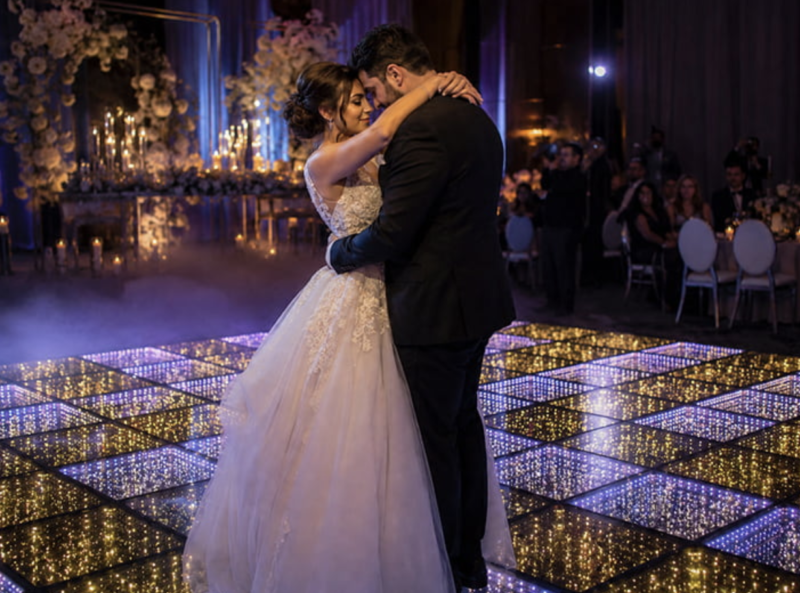
Every element of a wedding gets photographed, but the illuminated dance floor is in all of them. It sits under the first dance, the speeches and every wobbly phone video of the evening — a white LED floor under the couple’s monogram doubles a wedding’s social reach, because a hundred guests post versions of the same shot and the venue’s tag rides along on every one. Nightclubs learned the same lesson from the other direction: an interactive floor that ripples under footsteps is the reason people walk past the bar instead of stopping at it.
It sells the room.
This is also the only display we manufacture that people stand on. Nobody puts 70 kg onto one square centimeter of a video wall. Nobody spills a vodka-cranberry down a rental facade and buffs it out before the first dance. The floor gets all of it, the same night, then goes back in a truck. So the money question arrives in two flavors — what does Saturday cost, and what does the asset cost — and this guide answers both, including the failures I have already watched happen.
Two Readers, Two Paths
Google splits this market cleanly: “rent led dance floor” searches come from planners with a date; “led dance floor for sale” searches come from operators with a balance sheet. You already know which one you are.
Path A — renters. Wedding and party planners, corporate organizers, one-off events. You will never own a floor. You need a clean price per event, a contract without buried surprises, and a crew that turns up.
Path B — buyers. Venues, rental houses, nightclubs, hotel ballrooms. The floor is capital equipment, and you care about load ratings, spares, serviceability and payback.
Both audiences share one decision, and it burns them equally: interactive or not.
What an LED Dance Floor Actually Is
Strip away the glow and it is a rental cabinet on its back. A 500×500mm die-cast or steel frame, about 11–12 kg per panel, tempered glass face, module and power supply inside, locking connectors on the edges so panels bolt panel-to-panel and no cable ever crosses the dance surface. That last detail matters more than it sounds: a cable lying across a floor is a trip hazard and a crushed connector waiting for a flight case. On a proper floor, the wiring lives in the seam.
Some sellers list these as LED floor tiles — same product, smaller vocabulary. The face should be tempered glass with an anti-slip treatment, not bare acrylic: acrylic scratches into a haze within a season of mop traffic, and a scratched floor under uplighting looks dirty even when it’s clean. Resolution runs P4.81–P6.25, coarser than a screen — deliberately, because nobody reads text off a floor, and coarser pitch means bigger, cheaper, more forgiving LEDs behind the glass.
Four panels make a square meter — roughly 45 kg/m². A 4×4m floor runs 700–800 kg with controller and ramps. A two-person crew with a pallet jack moves that.
Renting: What Saturday Costs
The led dance floor rental market prices by the event, not the day. Market rates run $1,500–4,000 per event (illustrative — quotes swing hard by city and by what’s included). What drives the number: size (a 3×3m floor for 100 guests sits at the low end; a 6×6m ballroom floor means more panels, crew hours and truck), interactivity (adds hardware and an on-site operator), crew (install, program, strike — a floor that looks effortless took two techs three hours), and logistics (distance, stairs, union rules, overnight storage).
Before signing anything, walk the contract through five checks:
- What’s included: delivery, install crew, a tech on site during the event, and edge ramps — the beveled borders that stop heels and wheelchair castors catching the last row. Ramps are not optional; they are the difference between a floor and a liability claim.
- The weather clause if the event is outdoors: rain, wind and dew kill floors, and the contract should say who stops the show and when. The physics match any outdoor rental LED display, and our outdoor rental guide covers the wind-and-rain thresholds worth knowing.
- Power. A floor needs dedicated circuits, not a daisy chain off the bar. Get the amperage in writing and hand it to the venue electrician a week out.
- Damage terms. A cracked panel from a dropped speaker is nobody’s fault and somebody’s bill — know the replacement rate before it happens.
- Content. Who loads it, who tests it, what format the monogram needs — and who is standing next to the controller at 9 pm.
Load Ratings and the Stiletto Problem
Every listing says 500–1,500 kg/m² static load, and every buyer reads it and relaxes. Then a 70 kg guest in stilettos walks out for the first dance.
Her weight lands on a heel tip of roughly one square centimeter — and a stiletto strike at the start of a step multiplies that momentarily. The kg/m² figure describes a spread load: a crowd distributed across the surface, a piano on four feet. It tells you almost nothing about a heel.
What takes the hit is the glass face and the rib pattern underneath. Tempered glass, usually 4–6 mm, doesn’t fail from force alone; it fails when it flexes. The support ribs decide how far the face can deflect under a point load before the glass passes its strain limit. Two floors with identical marketing numbers can differ by a factor of three in real heel tolerance, purely on rib spacing and glass thickness.
So read glass thickness and rib geometry instead of the area figure — then ask for the point-load test result, not the area-load number. A real one uses a heel-shaped indenter loaded to a set weight, held, then repeated on the seam. Any factory that tour-proves its floors has run that test. If a vendor can’t produce a result, they have never put their floor under a wedding, and you’d be the test.
Water Lands on Top, Not Behind
Every other display we ship keeps water out. A dance floor invites it from above, on purpose, because drinks get spilled. That’s not an edge case — that’s Saturday.
Spill duty and rain duty are different specs. An IP54-class face shrugs off a spilled cocktail wiped up before midnight: sealed glass, gasketed edges. True rain duty — an outdoor wedding floor sitting through an evening shower — needs IP65-class panels and drainage planning, because water that gets past the face has to go somewhere. And the honest note: no floor panel survives a pool party. Not ours, not anyone’s. Submersion, splash-off from a pool edge, chlorinated water sitting in the seams all afternoon — that’s a replacement order, not a warranty claim.
Two details separate a good floor from a cheap one: edge trim and entry ramps (heels find seams — the seams are where glass edges chip and toes catch), and on outdoor builds, panels should sit on a drained subfloor rather than flat on wet grass, because a panel standing in a puddle spends the whole night testing its gaskets. Cleaning: a damp mop and neutral cleaner, never a pressure washer aimed at a seam.
Water always wins eventually. Your job is to make it win slowly.
Interactive Floors: What the Sensors Actually Do
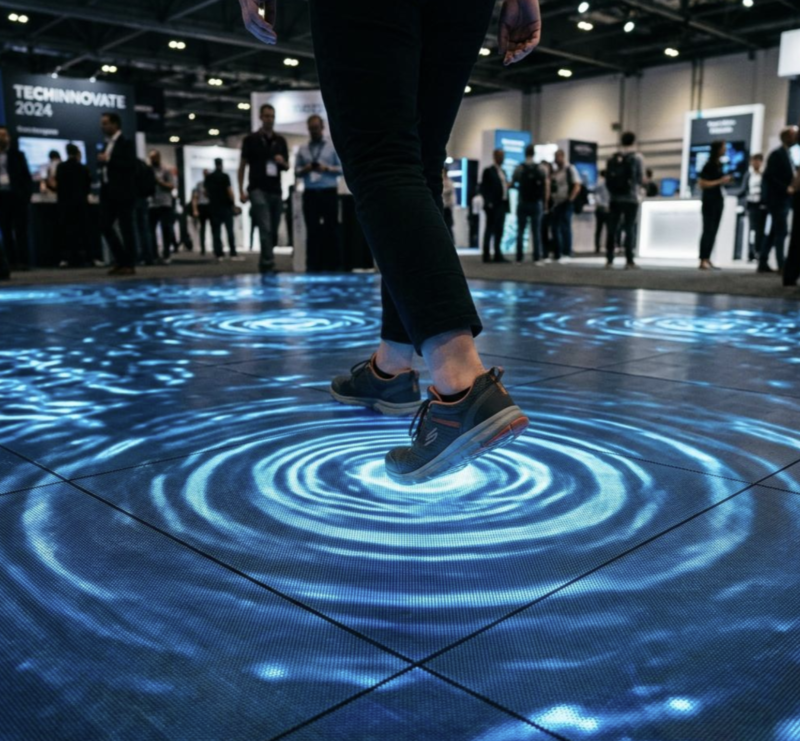
An illuminated dance floor comes in two flavors. Pre-rendered content is video playing under glass — patterns, logos, color washes; the floor doesn’t know anyone is standing on it and doesn’t care. Interactive floors do know.
The mechanism: pressure-sensing strips sit under the glass in each panel. A footstep loads the face, the strip reads the position, the controller turns it into coordinates, and the content reacts — ripples spreading out from under a shoe, trails following dancers. It lands well at events. It is also the most expensive failure mode we ship.
| Non-interactive | Interactive, pressure-sensing | |
| Biaya | $250–400/panel | $450–700/panel — sensors add $200–300/panel equivalent |
| Konten | Pre-rendered video, patterns, logos | Real-time reaction to footsteps |
| Failure surface | Panels and connectors | Panels, connectors, plus the sensor layer and interaction server |
| Operator | None | Tech on site |
| Wow factor | High | Higher — when it works |
The sensors carry one specific weakness: sensor strips die from water ingress long before the LEDs do. A spill the glass face shrugs off finds the sensor seam eventually when the sealing is mediocre. On rental fleets, dead sensors are the most common warranty call I see. Not dead pixels.
Stated plainly, from the line: most buyers do not need interactive. Pre-rendered content delivers 90% of the wow for 40% of the cost — guests respond to light under their feet more than to the ripple that follows any single footprint. Who genuinely needs it: nightclubs, where the reactive floor is the product; brand activations, where the interaction is the story; premium weddings, where the first-dance ripple is a differentiator the planner sells on. Everyone else should run good content on dumb tiles.
And ask one question above all: can sensors be retrofitted later? Some floors ship sensor-ready with the strips as a bolt-on; others are built one way and stay that way. If demand is uncertain, buy sensor-ready, run pre-rendered content for a season, upgrade when the bookings justify it.
LED Dance Floor Price: The Numbers to Budget
Factory-side, three tiers:
| Type | Price per panel | Price per m² |
| Non-interactive, P4.81–P6.25 | $250–400 | $1,000–1,600 |
| Interactive, pressure-sensing | $450–700 | $1,800–2,800 |
| Marketplace cross-check, retail MOQ-1 (published) | $440–750 | ~$1,760–3,000 |
The marketplace row is a sanity check, not a buy price: it’s what single units cost at retail, and for one floor it’s honestly not a bad deal against container economics. At rental-house volumes, factory pricing sits below it.
Worked example, 4×4m (64 panels, 16 m²): non-interactive 64 × 250–400 = **16,000–25,600 FOB**; interactive 64 × 450–700 = **28,800–44,800 FOB**. Add controller 300–800, then freight and import at 25–40% — a floor is heavy freight, and the weight is why that number doesn't budge. Budget a non-interactive 4×4m floor at roughly **20,000–36,000 all-in**.
Inside those ranges, four things move the price: glass thickness, steel versus aluminum frame, sensor inclusion, and pitch. Spend on glass and steel before pitch — underfoot, P4.81 versus P3.91 is invisible from standing height. A heel through a thin face is very visible. The pitch logic lives in our pixel-pitch guide.
Heat Goes Down
A wall dumps heat backward into open air. A floor dumps it into the void underneath, and that void is where permanent installs go wrong. If the panels sit over a floor box or plenum, ventilate it — seal a floor over a closed box and the box cooks: power supply life drops, sensor strips fail early, and you get failures a year in that trace back to heat nobody planned for. Keep the 70% rule on power sizing, same as any LED build.
Brightness is the counterintuitive spec: floors run dimmer than walls, deliberately. Nobody reads content at ankle height, but the floor still has to cut through club lighting and haze — the useful range sits around 1,500–2,500 nits. Chasing wall-grade brightness underfoot buys heat and nothing else.
The Fleet Spec That Survives Floors
Rental abuse kills floors faster than any spec failure. Panels get stacked, stacked wrong, and kicked across a dock. Floors lose panels to forklifts and dock corners, not to electronics — the LEDs outlive the logistics. Spec against the abuse:
- Full-steel frames, not aluminum, for anything that tours. Aluminum dies at the corners first, and a bent corner stops panels locking flat.
- Locking edge connectors rated for 200+ rig cycles. Cheap friction locks wear loose and the floor starts showing dark seams mid-event.
- Front-service panels — a dead tile mid-floor must swap from the top in minutes. Rear-service means tearing the floor apart at load-in. Non-negotiable.
- Flight cases, foam-cut, 4–6 panels per case, glass protected and corners padded — and the case count must include edge ramps and trim or they get left behind in some warehouse. Loose-stacked glass arrives cracked; tempered glass breaks into small blunt pieces and the panel underneath keeps glowing, which looks almost artistic until you price the replacement.
- Spares at 5–10% of panel count, bought as panels, not as a budget line. A 64-panel floor wants 4–6 spare tiles on the shelf.
- Quick-lock connectors, tool-free. If install needs a screwdriver per panel, crew hours double and margins halve.
One more question for any supplier: what does a replacement panel cost two years from now, and will they still stock it? If the answer is not a number and a yes, buy elsewhere. Long-term fleet support is the whole reason we hold 630 cabinets for our UK rental partner — see the arrangement on our P3.91 rental LED screen for the UK; the same logic applies to floors. For the full ownership math — cases, spares, controller, ramps — our rental LED display buying guide covers it, and it’s shorter than most people expect.
Buy or Rent an LED Dance Floor?
| Your situation | Call | Why |
| One-off event (wedding, party) | Rent | One use. Day rates beat capex every time. |
| Venue with weekly events | Buy | Utilization repays it inside two years; no repeat rental margins. |
| Rental house | Buy | The floor is your inventory. Day rates repay it in 1.5–2.5 years at 15–25 events/year. |
| Hotel ballroom | Buy, charge per event | The asset sits on site; a per-event floor fee becomes a profit line. |
| Corporate AV department | Usually rent | Low utilization; capex sign-off for twelve Saturdays a year is a hard sell. |
One caveat for rental houses: the payback assumes you sell the floor. A floor that lives in the warehouse repays nothing — which argues for buying one and marketing it hard before buying a second. A ballroom booking weekend weddings can own a floor and rent it out on dark weekends; a venue running three events a year shouldn’t own one at all.
Sizing, and the Three Numbers
| Floor size | Area | Panels at 500×500mm | Typical use |
| 3×3m | 9 m² | 36 | Intimate weddings to ~100 guests |
| 4×4m | 16 m² | 64 | Standard wedding floor, 150–200 guests |
| 5×5m | 25 m² | 100 | Large weddings, small club floor |
| 6×6m | 36 m² | 144 | Ballrooms, nightclubs, brand activations |
When you are ready to quote, send three numbers: size, interactive or not, buy or rent. Pitch, content and freight all follow from those three.
FAQ
How much does it cost to rent an LED dance floor for a night? Market quotes land between $1,500 and $4,000 for a single event, depending on size, interactivity, crew and travel — set by your local market, not the factory. Quotes that look cheap usually mean older panels, no ramps, or no spares. Ask what’s included: controller, edge trim, ramps, a tech on site decide whether the night works.
Is an LED dance floor slippery when wet? The tempered glass face normally carries an anti-slip treatment, and reputable floors carry a slip-resistance spec — ask for it. Wet shoes on wet glass is still a real risk: outdoor events need the weather clause, covered staging, and a tech who wipes spills the moment they happen.
Can an LED dance floor get wet? Spills, yes — an IP54-class glass face handles a drink wiped up that same night. Rain, only with IP65 panels and drainage planning. Submersion, no: no panel survives a pool party, whatever the listing says.
Will heels damage the floor? Not if the build is right. The area-load rating won’t protect you — a heel concentrates 70 kg onto roughly a square centimeter and the glass flexes before it breaks. Glass thickness and the rib pattern decide heel survival, so ask for the point-load test result before you ask about anything else.
Can I start small and add panels later? Yes, with one condition: same production line, matched batch, matched firmware. Panels from different runs show visible color shift side by side, which is why expansion panels should come from the original supplier, ordered against your original batch reference.
Tell us size, interactivity and buy-vs-rent — we’ll quote the floor and, if you’re renting something this Saturday, tell you that too. → Contact us
Not a trunk job.