
Naked-Eye 3D vs Holographic vs Transparent LED: Which One Wins for Retail Storefronts in 2026?
Reading time: ~13 min | Best for: Brand managers, visual merchandising directors, retail design architects, and AV integrators evaluating “invisible-screen” display formats for storefronts.
The 30-second version
If you are choosing a “wow factor” display for a retail storefront, the decision tree is simpler than vendors make it sound:
| Your situation | Recommended format | Typical cost / m² |
|---|---|---|
| Street-facing flagship, high foot traffic, want to go viral | Naked-eye 3D LED (anamorphic) | USD 2,500–6,000 |
| Trade show booth, pop-up activation, short-term wow | Holographic LED (fan or reflective) | USD 1,200–4,000 |
| Permanent storefront window, daily content rotation, product visibility matters | Transparent LED (film or glass) | USD 400–2,500 |
| Outdoor building facade, large-scale branding | Transparent LED mesh | USD 200–600 |
If your project falls in the transparent LED rows, the rest of this guide explains which sub-format and pixel pitch to specify. If you are leaning toward 3D or holographic, read the failure-mode sections first — those formats have hidden costs that most suppliers will not mention until after the PO.
This guide is written for buyers who have a budget, a location, and a business goal—and need to know which of these three formats actually delivers on that goal. We manufacture transparent LED displays, so we have an obvious bias. But we also see what happens when clients buy the wrong format, and the data below is drawn from 200+ retail installations across 18 countries.
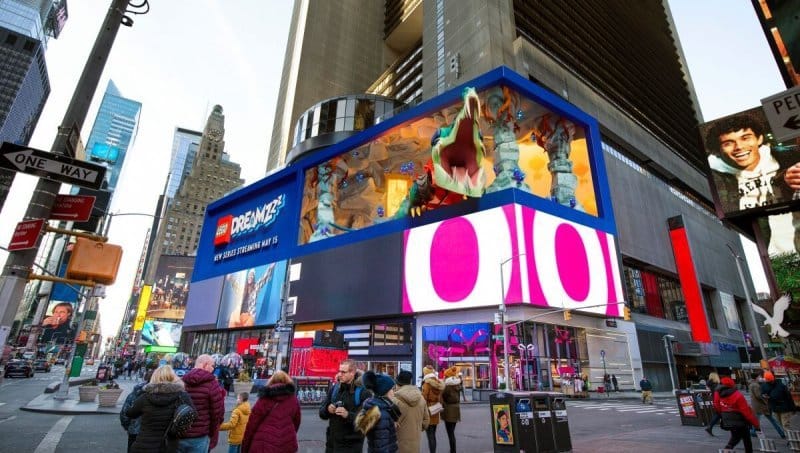
Why 2026 Retailers Are Choosing “Invisible-Screen” Formats Over Traditional Signage
Three years ago, a retail storefront display meant one of two things: a static lightbox poster or a conventional LED video wall bolted over the window. Both had the same problem — they blocked the view of the product inside.
That trade-off no longer makes sense. In 2026, physical retail survives on experience and impulse. If a pedestrian cannot see the product through the window, the display is competing with the product for attention. The formats winning in 2026 are the ones that disappear when needed and reappear on cue:
- Naked-eye 3D LED creates a volumetric illusion that makes pedestrians stop and film—driving social-media amplification.
- Holographic LED floats images in mid-air for trade-show and event activations.
- Transparent LED turns the window glass itself into a display surface while preserving 65–93% visual transparency.
All three share a promise: “the screen disappears.” But they achieve it through entirely different physics, at entirely different price points, with entirely different operational realities. Choosing based on YouTube demo videos rather than procurement criteria is the fastest way to waste USD 50,000–200,000 on a format that does not fit your location, your content workflow, or your maintenance capacity.
Naked-Eye 3D LED: How the Anamorphic Illusion Works (and Where It Fails)
What it is
Naked-eye 3D LED displays are not truly three-dimensional. They are large-format LED video walls — usually L-shaped (corner wrap) or curved — that play pre-rendered anamorphic content. The 3D effect is an optical illusion achieved through forced perspective: the content is distorted in production so that, when viewed from a specific “sweet spot” (typically 10–30 meters dead-center), the human brain reconstructs a 3D scene.
Step two meters to the left or right of the sweet spot, and the illusion collapses into a warped, distorted image.
Where it works
- High-footfall urban intersections (Tokyo Shibuya Cross, Chengdu Chunxi Road, New York Times Square) where hundreds of pedestrians pass the sweet spot per minute
- Large-format outdoor billboards (typically 100–500 m²) where the viewing distance is naturally 15–50 meters
- Viral marketing campaigns where the goal is social-media shares, not daily content rotation
Where it fails
- Sweet-spot dependency. A naked-eye 3D display installed on a narrow shopping street with a 5-meter-wide sidewalk has almost no usable sweet spot. Pedestrians walk past at 1.2 m/s and never stand in the right place. The “3D” effect is invisible to 80%+ of passersby.
- Content cost. Anamorphic content is not something your marketing intern can produce in Canva. A single 15-second anamorphic clip costs USD 8,000–25,000 from a specialized 3D production studio. Most installations run 3–6 clips in rotation—that is USD 24,000–150,000 in content alone before the screen is turned on.
- Size requirement. The 3D illusion only works at scale. Below approximately 80 m² of display area, the forced-perspective effect is too weak to register. A 20 m² naked-eye 3D screen on a boutique storefront will look like a regular LED wall playing a slightly weird video.
- Permitting and structural load. L-shaped corner wraps require structural steel framing rated for wind load, seismic load, and access for maintenance. In many cities, a 200 m² exterior LED installation requires a billboard permit, a structural engineering sign-off, and a public-safety review—a 6–12 month approval process.
Cost reality:
| البند | Typical range |
|---|---|
| Display hardware (P2.5–P4 outdoor, L-shaped, or curved) | USD 2,500–6,000 / m² |
| Structural steel frame + installation | USD 800–2,000 / m² |
| Anamorphic content production (3 clips, 15 sec each) | USD 24,000–75,000 |
| Annual content refresh (2–3 new clips) | USD 16,000–50,000 / year |
| Permitting + structural engineering | USD 5,000–20,000 |
Total first-year cost for a 150 m² installation: USD 600,000–1,200,000+.
Holographic LED Display: 3 Types and Why Most Retail Buyers Pick the Wrong One
“Holographic LED display” is a marketing term applied to three completely different technologies. If you do not know which one you are buying, you will be disappointed.
Type 1: LED Fan Display (Spinning LED Hologram)
A high-speed rotating LED blade (typically 40–95 cm diameter) spins at 750–1,500 RPM, creating a persistence-of-vision (POV) illusion of a floating image. The blade is thin and nearly invisible when spinning, so the image appears to float in mid-air.
- Resolution: 450–1024 px diameter (very low; suitable for logos, simple text, basic animations)
- السطوع: 1,500–3,000 nits (indoor only; unusable in sunlight)
- Typical price: USD 120–800 per unit
- Best for: Trade show booths, pop-up activations, point-of-sale displays
- Failure mode: Motor bearings wear out in 6,000–10,000 hours of continuous operation. A fan running 12 hours/day will need motor replacement every 14–24 months. The spinning blade is also a safety hazard—protective housing is mandatory in public-access areas.
Type 2: Reflective Holographic Display (Hologram Pyramid / Showcase)
A transparent foil or glass reflector is angled at 45° over a hidden LED screen playing specially mapped content. The viewer sees a reflection that appears to float inside the showcase. This is the technology behind most “hologram” retail product reveals.
- Resolution: Depends on the hidden LED source (typically P1.5–P2.5)
- السطوع: Low—the reflective foil loses 50–70% of the source brightness
- Typical price: USD 1,500–8,000 per unit (showcase sizes 20–60 cm)
- Best for: Jewelry counter displays, luxury product launches, museum exhibits
- Failure mode: The reflective foil scratches easily and accumulates dust. After 12–18 months in a retail environment, the “hologram” looks cloudy. Replacement foil costs USD 200–600 per panel. The viewing angle is also narrow—only 2–3 people can see the effect simultaneously.
Type 3: Pepper’s Ghost LED Stage (Large-Format Hologram)
A large angled glass or film surface reflects an LED screen hidden below or behind the stage. This is the technology used in concerts (Tupac hologram, ABBA Voyage) and large brand activations.
- Resolution: Depends on hidden LED source (P2.5–P3.9)
- السطوع: Moderate — requires a controlled lighting environment
- Typical price: USD 15,000–80,000 per installation
- Best for: Product launch events, conference keynotes, concert stages
- Failure mode: Requires a darkened environment and precise viewing geometry. Completely unsuitable for a sunlit retail storefront. Also requires significant floor depth (2–4 meters behind the glass for the hidden screen)—rarely available in a standard retail layout.
The honest assessment: Holographic LED displays are event and activation tools, not permanent storefront infrastructure. If your use case is “3 days at a trade show” or “a 2-week product launch window,” a fan display or reflective showcase is cost-effective and impressive. If your use case is “a display that runs 12 hours/day, 365 days/year in my storefront window,” holographic formats will not survive the operational reality.
Transparent LED: The 4 Sub-Formats Every Buyer Should Know
Transparent LED is the one format among the three that is designed for permanent, daily-use retail installations. “Transparent LED” is a category, not a product — here are the four sub-formats:
Sub-format 1: LED Glass Screen (Frameless)
LED chips embedded between laminated glass layers. Nearly invisible when off.
- Transparency: 70–85%
- Pixel pitch: P3.9–P10
- Price: USD 800–2,500 / m²
- Best for: Flagship stores, luxury automotive showrooms, permanent installations
Sub-format 2: LED Film Screen (Adhesive)
Ultra-thin LED film (0.5–1.5 mm) applied directly to existing glass with optical adhesive.
- Transparency: 65–80%
- Pixel pitch: P5–P10
- Price: USD 400–900 / m²
- Best for: Retail pop-ups, short leases, leasehold buildings where glass cannot be replaced
Sub-format 3: LED Mesh Screen (Curtain)
LED strips mounted on flexible mesh, hung behind or in front of glass.
- Transparency: 80–93%
- Pixel pitch: P25–P50 (coarse; not for close-up viewing)
- Price: USD 200–600 / m²
- Best for: Outdoor building facades, large-scale architectural branding
Sub-format 4: Transparent LED Cabinet
Standard modular LED cabinet with transparent PCBs and wider module spacing.
- Transparency: 50–75%
- Pixel pitch: P2.8–P7.8
- Price: USD 600–1,800 / m²
- Best for: Indoor retail (mall atriums, showroom floors), fine-pitch applications
For a deeper dive into transparency rates, brightness requirements, and installation methods for each sub-format, see our Transparent LED Display for Store Windows: 2026 Complete Buying Guide.
Side-by-Side Comparison: 7 Dimensions That Actually Matter
| Dimension | Naked-Eye 3D LED | Holographic LED | Transparent LED |
|---|---|---|---|
| Hardware cost / m² | USD 2,500–6,000 | USD 1,200–4,000 | USD 400–2,500 |
| Brightness (nits) | 5,000–10,000+ | 1,500–3,500 | 4,000–6,000+ |
| Content complexity | Very high (anamorphic studio required) | High (specialized mapping) | Low (standard video/motion graphics) |
| Content cost per clip | USD 8,000–25,000 | USD 2,000–8,000 | USD 200–1,500 (or in-house) |
| Daily maintenance | Low (sealed outdoor panels) | High (motors, foils, alignment) | Low (modular replacement) |
| Expected lifespan | 80,000–100,000 hrs | 6,000–15,000 hrs (fans/foils) | 80,000–100,000 hrs |
| Permitting difficulty | Very high (billboard-class) | Low (indoor device) | Low–Moderate (interior-mounted) |
| Product visibility through display | None (opaque) | Partial (reflective) | 65–93% (primary feature) |
The pattern: Naked-eye 3D and holographic formats trade cost and maintenance for spectacle. Transparent LED trades spectacle for sustainability—it is the only format that can run every day, all year, without a dedicated content team or specialized maintenance contract.
ROI Reality Check: What Each Format Delivers Per USD 1,000 Invested
Let us model a realistic scenario: a 30 m² retail storefront display in a mid-tier shopping district (not Times Square, not a dead alley). Budget envelope: USD 100,000, including hardware, installation, and first-year content.
Scenario A: Naked-Eye 3D LED (30 m²)
- Hardware + structure: ~USD 105,000 (already over budget at minimum specs)
- Content: USD 24,000 minimum (3 clips)
- Total Year 1: USD 129,000+
- Expected outcome: Strong social-media engagement in weeks 1–4. Engagement decays sharply after content is seen by regular foot traffic (typically 4–6 weeks). Requires USD 16,000–50,000/year in fresh content to maintain impact.
- ROI verdict: Break-even only if the location generates significant viral social media and the brand has a content budget to refresh quarterly. Most mid-tier locations will not see ROI within 24 months.
Scenario B: Holographic LED (Fan array, 30 m² equivalent)
- Hardware: ~USD 36,000 (90 fan units at USD 400 avg)
- Content: USD 6,000
- Total Year 1: USD 42,000
- Expected outcome: High novelty factor for 2–4 weeks. After that, the low resolution and motor noise become noticeable. Motor replacements begin at month 14–18. By year 2, the display looks tired and requires reinvestment.
- ROI verdict: Suitable for a 3-month pop-up or trade-show circuit. Not viable as permanent storefront infrastructure.
Scenario C: Transparent LED Film (30 m², P7.8)
- Hardware: ~USD 21,000 (USD 700/m² avg)
- Installation: ~USD 4,500
- Content: USD 2,000 (or in-house)
- Total Year 1: USD 27,500
- Remaining budget for content iteration: USD 72,500
- Expected outcome: Daily content rotation (promotions, brand campaigns, and seasonal messaging) with product visible through the window. No content production bottleneck — standard motion graphics work. Lifespan 80,000+ hours (7+ years at 12 hrs/day).
- ROI verdict: Lowest total cost of ownership. Break-even typically at 8–14 months for retailers who use the display for daily promotional messaging. The display pays for itself in saved print/signage costs and incremental foot traffic conversion.
The takeaway: Transparent LED delivers more impressions per dollar over a 24-month horizon—by a factor of 3–5x—because it runs daily without content-production friction. 3D and holographic formats are sprinters; transparent LED is a marathon runner.
The 5 Costly Mistakes Retailers Make When Picking a “Wow Factor” Display
Mistake 1: Buying the format that went viral on LinkedIn
A brand director sees a naked-eye 3D billboard clip with 2 million views and assumes the same effect will work on their 25 m² storefront. It will not. The viral clips you see online are filmed from the exact sweet spot, on 200+ m² installations, at flagship urban intersections. A smaller installation on a side street will produce a flat, slightly distorted video — not a viral moment.
Rule: If your display area is under 80 m² and your foot traffic is under 5,000/day, naked-eye 3D is the wrong choice.
Mistake 2: Confusing “holographic” with “transparent”
Many buyers use “holographic LED” and “transparent LED” interchangeably. They are different technologies with different physics. A holographic fan display produces a low-resolution floating image visible from a narrow angle. A transparent LED film produces a full-resolution video display visible from a wide angle, with the product visible through the glass. If a supplier uses “holographic” to describe a transparent LED film, ask them to clarify the technology—or find a different supplier.
Mistake 3: Underestimating content production costs
The hardware is 30–50% of the total cost of ownership over 3 years. The rest is content. Naked-eye 3D requires USD 16,000–50,000/year in specialized content. Holographic formats require custom-mapped content. Transparent LED can run standard 1080p/4K motion graphics — the same content your team already produces for digital signage and social media. If your marketing team does not have a content production workflow, transparent LED is the only format that will not become a financial burden.
Mistake 4: Ignoring maintenance reality
Holographic fan displays need motor replacements every 14–24 months. Reflective holographic foil needs replacement every 12–18 months. Naked-eye 3D installations on building exteriors require specialized rigging crews for panel replacement—a single dead module can cost USD 1,500–3,000 to service because of access equipment. Transparent LED film and cabinet screens are modular: a single panel swap takes 15 minutes and costs USD 80–200 in parts.
Ask the supplier: “What is the cost and lead time for replacing one dead module?” If the answer involves scaffolding, rigging, or a 4-week lead time, factor that into your TCO model.
Mistake 5: Not checking local permitting before specifying the format
Exterior LED installations — including naked-eye 3D wraps and transparent mesh on building facades — are subject to sign/billboard permitting in most jurisdictions. Interior-mounted transparent LED film applied to existing window glass is typically exempt from billboard permits because it is classified as interior signage. This difference can save 6–12 months of approval time and USD 5,000–20,000 in permit fees.
Before specifying any format: Check your local sign code for “electronic message center” (EMC) restrictions, brightness limits, and permitting requirements for exterior vs. interior-mounted displays.
Eyecatchmedia’s Transparent LED Lineup for Retail
We manufacture transparent LED displays for retail storefronts. Our lineup covers all four sub-formats:
Indoor Transparent LED Cabinet (P2.9–P6.2)
- السطوع: 4,500–6,000 nits
- Transparency: 55–75%
- Best for: Shopping mall interiors, showroom floors, atrium installations
- MOQ: 1 cabinet (0.5 m²)
- Lead time: 12–15 working days
Window-Mounted LED Film (P5.2–P7.8)
- السطوع: 4,500–5,500 nits
- Transparency: 70–80%
- Best for: Storefront window overlays, leasehold installations, pop-up retail
- MOQ: 1 m²
- Lead time: 10–12 working days
- Custom sizes: Cut to your window dimensions (max single panel: 1.5 m × 3 m)
Transparent LED Glass Screen (P3.9–P7.8)
- السطوع: 4,000–5,000 nits
- Transparency: 70–85%
- Best for: Flagship stores, luxury automotive showrooms, permanent installations
- MOQ: 1 m²
- Lead time: 20–25 working days (custom laminated glass)
Outdoor Transparent Mesh (P15.6–P31.2)
- السطوع: 5,500–7,500 nits
- Transparency: 85–93%
- Best for: Building facades, large-scale architectural branding, outdoor curtain effects
- MOQ: 5 m²
- Lead time: 15–18 working days
What we provide with every order:
- Free 3D mockup of your window with the specified display format applied
- Site survey checklist (brightness, glass type, structural load, electrical routing)
- Content template pack (10 retail-ready motion graphics in 1080p/4K)
- 3-year warranty on LED modules; 5-year warranty option available
FAQ
Can a transparent LED display produce a 3D effect? Not a true naked-eye 3D illusion. However, creative content with depth cues (parallax, shadows, layering) on a high-brightness transparent LED film can produce a compelling pseudo-3D effect at a fraction of the cost. For most retail brands, this achieves 80% of the “wow” at 20% of the cost.
How long does transparent LED film last? Rated lifespan is 80,000–100,000 hours. At 12 hours/day, that is 18–23 years of operation. In practice, brightness depreciation reaches 20–30% by year 7–8, which is when most retailers refresh the display.
Can I install transparent LED film on low-E glass? Low-E (low-emissivity) glass coatings can interfere with the optical adhesive bond. We provide a specialized adhesive primer for low-E glass at no additional cost. Confirm your glass type before ordering.
What is the minimum order for a retail window? We accept orders from 1 m². A typical boutique window (3 m × 2 m = 6 m²) with P7.8 film costs approximately USD 4,200–5,400, including driver units and mounting hardware.
Do you ship globally? Yes. We export to 60+ countries with CE, FCC, RoHS, and E-Mark certifications. Typical shipping time: 5–12 days by sea freight, 3–5 days by air freight.
Next Steps
If you are evaluating a retail storefront display and want to know whether transparent LED is the right format for your location:
- Send us your window dimensions and photos — we will produce a free 3D mockup within 48 hours.
- Request a brightness assessment — tell us your window orientation and city, and we will specify the minimum brightness and pixel pitch for your environment.
- Get a quote—MOQ from 1 m², lead time 10–15 working days, global shipping.
Email: [email protected] WhatsApp: +86 18727113956 Request a quote: Eyecatchmedia Transparent LED Quote Form